MARKETS
L’effondrement du modèle salarial : le calcul que votre employeur a déjà fait
Le salariat ne meurt pas de licenciements. Il meurt par l’entrée, par la fiche de paie et par l’impôt. L’IA décroche la valeur du salaire, et tout ce qu’on y avait accroché doit trouver un autre clou.


Lundi 26 octobre 2026. Environ 60 000 salariés de Microsoft, à peu près un quart de l’entreprise, ouvrent un e-mail qui leur propose de partir. Volontairement, avec une indemnité. Réponse attendue début décembre.1 Ce n’est pas une entreprise en difficulté : son chiffre d’affaires vient de progresser de 18 % sur l’exercice, et deux jours plus tard elle annonce une croissance de 48 % sur Azure, son cloud.2 Une entreprise qui gagne plus que jamais propose à un salarié sur quatre de s’en aller.
Sur les réseaux, deux récits s’affrontent aussitôt. Le premier : « l’informatique est finie », l’IA remplace les développeurs, sauve qui peut. Le second, plus rassurant : c’est un énième plan d’économies, la tech corrige ses embauches du Covid, rien de neuf sous le soleil. Les deux ont tort, et pour la même raison… Ils regardent les licenciements.
Le salariat ne va pas mourir de licenciements. Il va mourir par l’entrée, par la fiche de paie et par l’impôt.
Ma thèse est simple : nous vivons la fin d’un cycle de cent quarante ans, celui où le salaire était à la fois la porte d’entrée dans la vie adulte, le canal de partage des gains de productivité et la meilleure assiette fiscale jamais inventée. L’IA ne fait pas disparaître le travail. Elle décroche la valeur du salaire. Et tout ce qu’on avait accroché au salaire va devoir trouver un autre clou.
1. L’escalier sans première marche
Commençons par ce que les chiffres du chômage ne montrent pas.
Aux États-Unis, le taux de chômage était de 4,2 % en septembre, plus bas qu’un an plus tôt.3 Tout va bien, donc. Sauf que si l’on découpe au lieu d’agréger, une autre image apparaît.
Trois chiffres, lus dans l’ordre, suffisent à voir l’escalier :
- 5,2 % de chômage chez les jeunes diplômés américains au troisième trimestre 2026, contre 4,2 % pour l’ensemble des actifs, et 42,5 % d’entre eux dans un emploi qui ne demande pas leur diplôme.4
- 19 % : dans les métiers les plus exposés à l’IA, l’emploi des 22–25 ans est 19 % en dessous de celui de leurs pairs moins exposés. Les plus âgés, dans les mêmes métiers, ne perdent rien. Et l’écart ne vient pas de licenciements : il vient d’embauches qui n’ont pas lieu.5
- 71 % : quand les offres d’emploi de développeurs ont recommencé à monter, 71 % de la reprise concernait des postes seniors.6
Historiquement, un diplôme protégeait du chômage mieux que la moyenne. Ce n’est plus le cas.
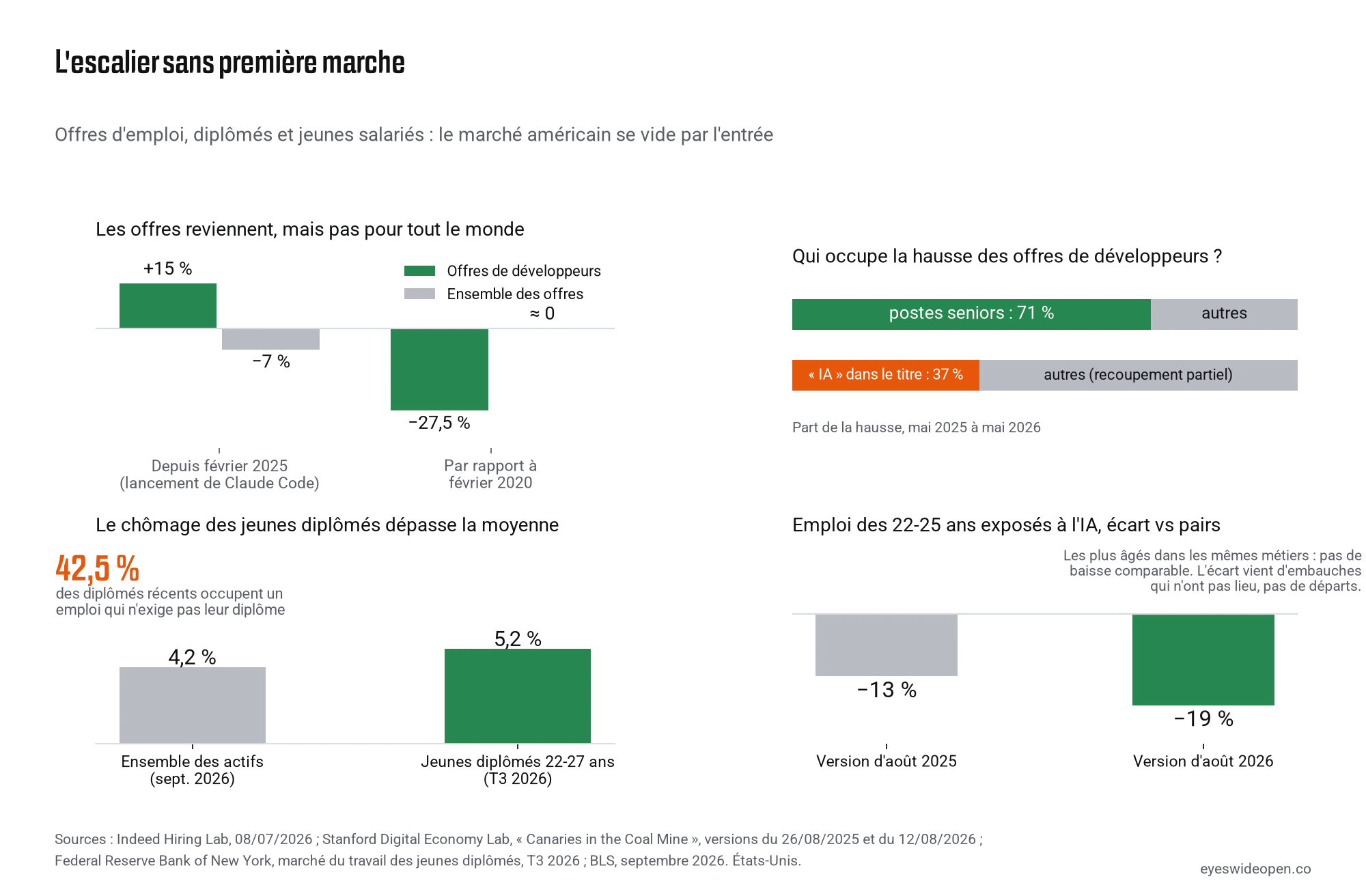

L’escalier sans première marche : offres, diplômés, jeunes salariés exposés (États-Unis).
Traduction : l’IA remplace d’abord les tâches qu’on confiait aux débutants, celles qui sont codifiables, vérifiables, répétitives. Et elle complète le jugement des anciens. Le salariat ne s’effondre pas par le haut, avec des plans sociaux spectaculaires. Il se vide par le bas, sans bruit, comme un escalier dont on aurait retiré la première marche. Ceux qui sont déjà en haut ne voient rien. Ceux qui arrivent ne peuvent plus monter.
En France, c’est encore plus silencieux. Licencier coûte cher et prend du temps, donc on ne licencie pas : on ne remplace pas. On gèle une embauche, on signe une rupture conventionnelle de plus (plus de 500 000 par an7). Rien de tout ça ne déclenche de plan social ni de statistique dédiée. Le chômage reste stable, et l’assiette† s’érode. Un trou sans coupable.
Et il y a une bombe à retardement dans cette mécanique : si personne ne fait plus le travail de junior en 2026, qui aura l’expérience de senior en 2035 ? On appelle ça une dette d’apprentissage‡. Elle ne figure dans aucun bilan, et elle se paiera d’un coup. (Qui saura juger si le système marche ? On y revient dans notre thèse sur la délégation du jugement.)
†assiette : base sur laquelle un prélèvement est calculé. L’assiette des cotisations sociales, c’est la masse des salaires : moins il y a de salaires versés, moins il y a de cotisations, quel que soit le taux.
‡dette d’apprentissage : savoir-faire qui ne se transmet plus parce qu’on n’embauche plus de débutants pour l’acquérir. Comme une dette financière, elle s’accumule sans bruit, puis réclame son remboursement d’un seul bloc.
2. Les salariés, variable d’ajustement des data centers
Revenons à Microsoft, parce que l’entreprise nous montre le deuxième mécanisme en direct.
Sur l’exercice clos fin juin, trois lignes du même bilan :8
- Chiffre d’affaires : +18 % (331,8 milliards de dollars).
- Résultat net : +31 % (133,7 milliards, dont près de 5 milliards de gains liés à OpenAI).
- Effectif : d’environ 228 000 à 223 000 personnes.
Au trimestre suivant, elle a investi environ 39 milliards de dollars, en un seul trimestre, dans ses infrastructures. Rob Enderle, analyste qui suit la tech depuis quarante ans, l’a résumé en mai à propos de la vague de licenciements : « C’est le coût de l’IA qui dérègle les comptes de résultat. »9
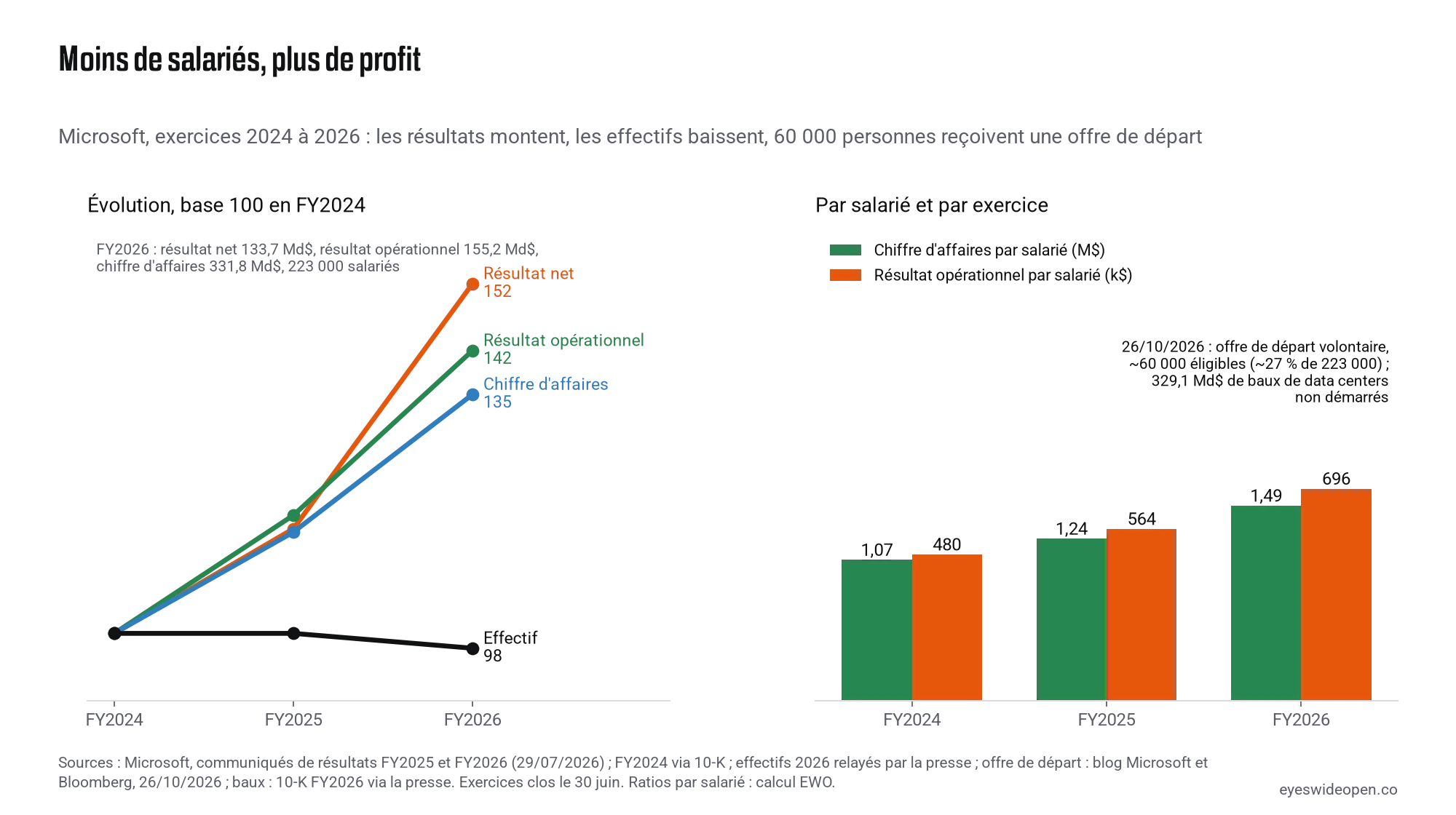
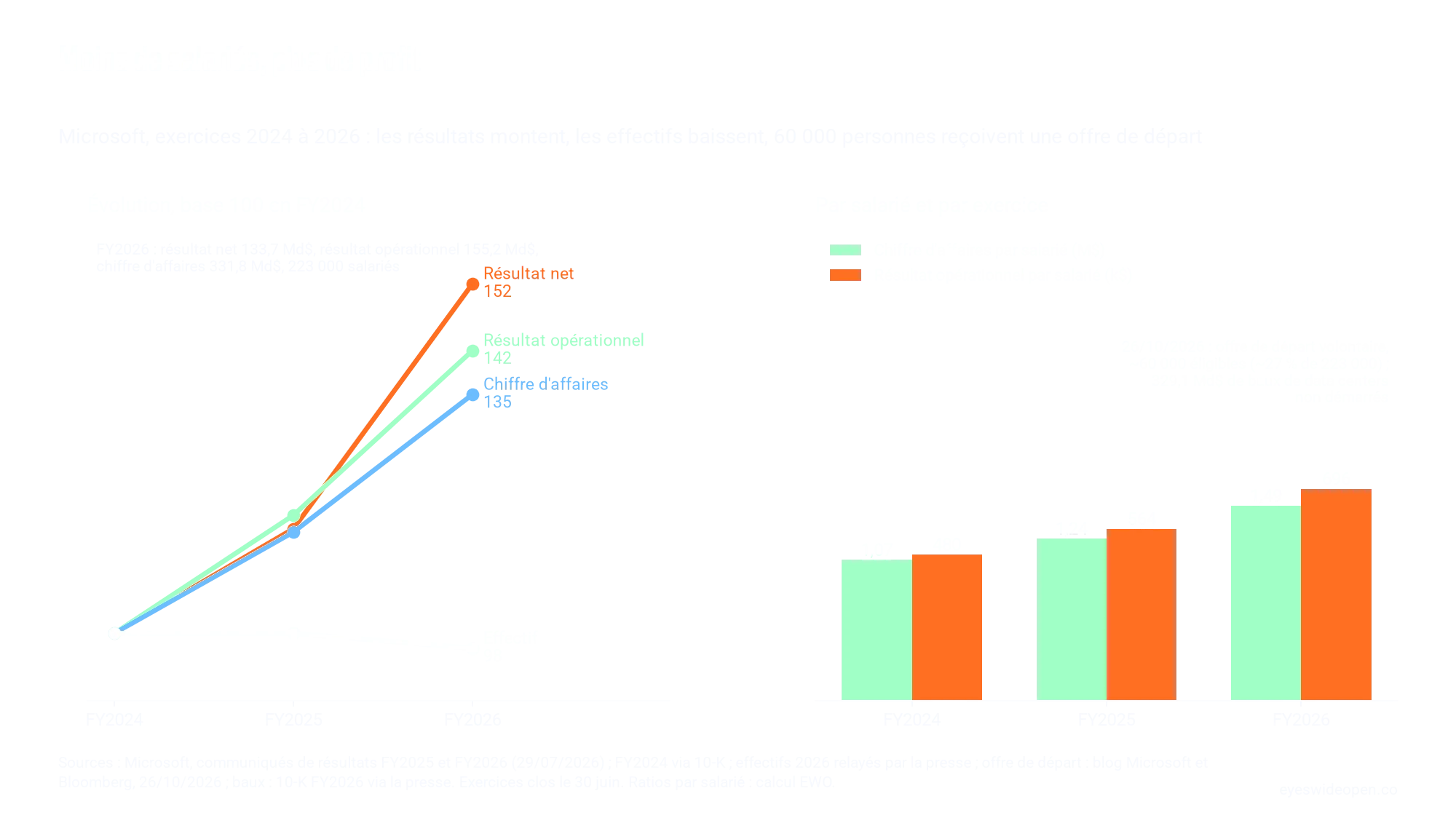
Moins de salariés, plus de profit : Microsoft, exercices 2024 à 2026.
Le mécanisme est simple, presque mécanique. Un data center, ça s’amortit sur des années : c’est une charge fixe, gravée dans les comptes. Le prix de vente, la concurrence le fixe. Il reste une seule ligne qu’on peut piloter trimestre après trimestre pour tenir la marge que les marchés attendent… la masse salariale. Ce n’est pas que l’IA fait déjà le travail de 60 000 personnes. C’est qu’elle coûte si cher à construire que les salariés ont été priés de payer la facture.
Et le marché applaudit. Le 26 février, Block, la fintech de Jack Dorsey, annonce plus de 4 000 suppressions de postes, environ 40 % de l’effectif, au nom d’« équipes plus petites et plus plates » équipées d’outils d’IA. L’action bondit d’environ 20 % après la clôture (près de 17 % à la clôture suivante), le soir où Block publie aussi des résultats en hausse.10 Quand la Bourse ajoute près de 20 % le soir où l’on se sépare de deux salariés sur cinq, nul besoin de mémo : tous les conseils d’administration de la planète viennent de lire le cours.
Le cabinet Challenger, qui compte les suppressions de postes annoncées aux États-Unis, a vu l’IA devenir en 2026 le premier motif déclaré : 116 175 postes de janvier à août, 22 % du total, plus du double de toute l’année 2025, et 120 136 à fin septembre.11
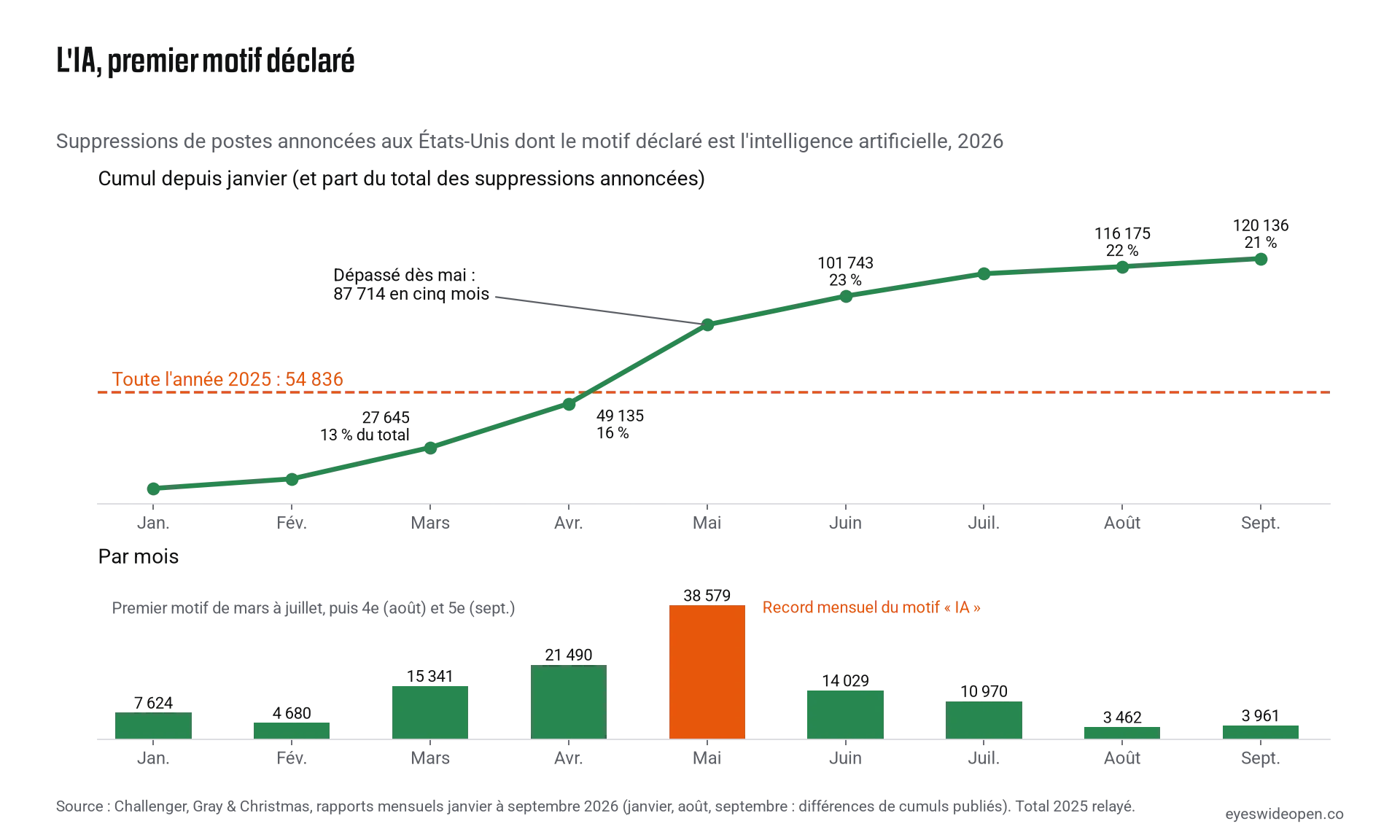
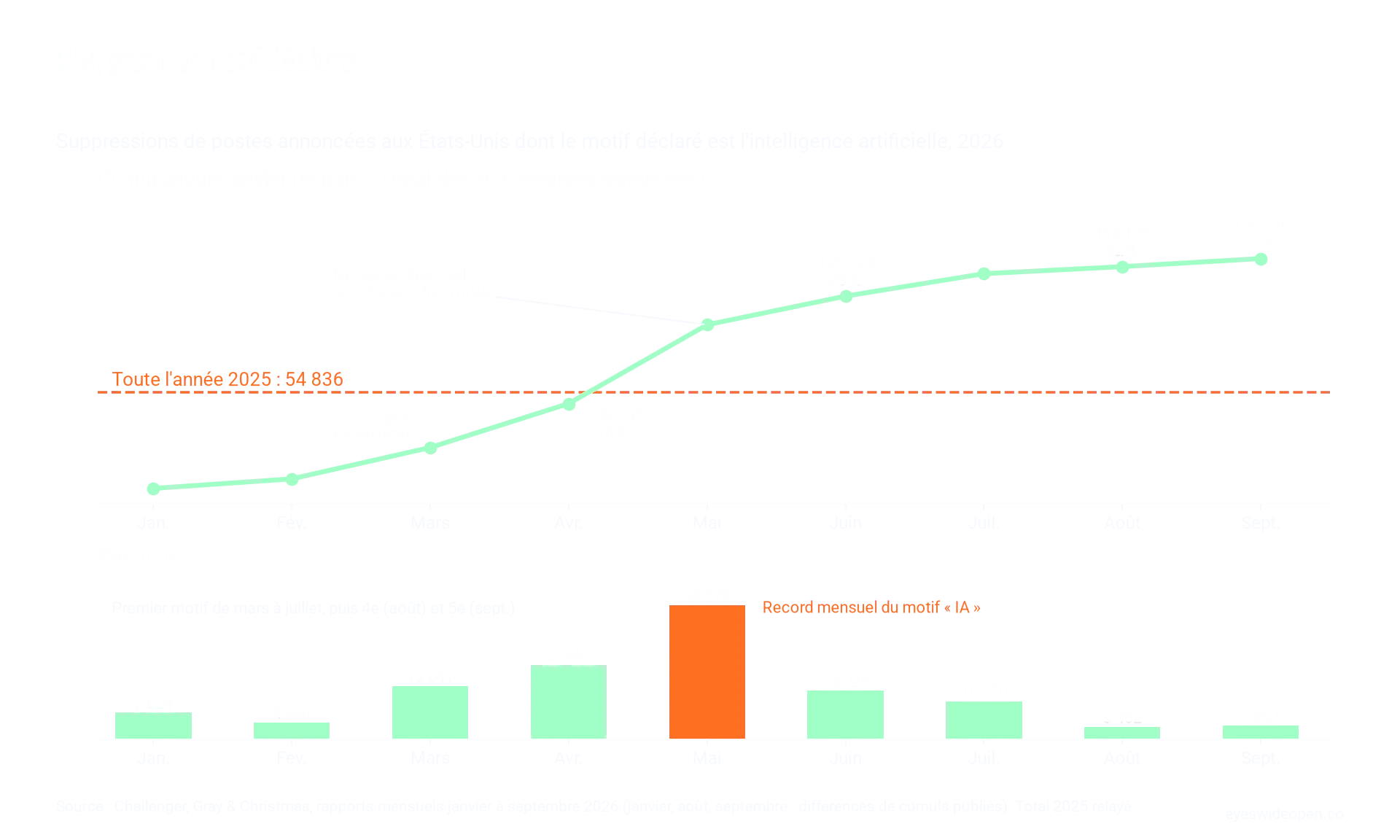
L’IA, premier motif déclaré : suppressions de postes annoncées aux États-Unis, en cumul et par mois, 2026.
Alors, soyons honnêtes : une partie de ces annonces relève du AI-washing†. Dire « IA » rapporte en Bourse, dire « on a trop embauché pendant le Covid » rapporte moins. Andy Jassy lui-même a expliqué, au moment des 14 000 suppressions de postes d’Amazon, qu’elles tenaient à la « culture » et aux couches de management plus qu’à l’IA.12 Mais ça ne change rien au fond : que l’IA remplace vraiment les postes ou qu’elle serve de prétexte pour les couper, le résultat sur la fiche de paie est le même. Et le prétexte, quand il est récompensé, devient une stratégie.
†AI-washing : par analogie avec le greenwashing, fait d’attribuer à l’IA des suppressions de postes qui tiennent à d’autres causes (sureffectif, coûts, marges), parce que le récit est mieux accueilli par les marchés.
3. La subvention invisible
Le troisième mécanisme est le plus français, et celui dont personne ne parle. La chaîne IA et Stratégie l’a posé en détail dans une vidéo du 24 août, et je lui emprunte le raisonnement.13
Prenez un cadre payé 60 000 euros brut par an. Voici ce que ça donne (ordres de grandeur, à reprendre sur le simulateur de l’Urssaf avant toute décision) :
- Il coûte à son employeur environ 85 500 euros par an.
- Il en touche environ 47 200 net, avant impôt sur le revenu.
- En face, un agent d’IA haut de gamme coûte 200 dollars par mois, soit 2 400 dollars par an, et aucune cotisation n’y est prélevée.
Je ne vais pas vous faire le coup du « un forfait remplace un cadre » : c’est faux, et les études le montrent : l’organisation METR a mesuré, début 2025, que seize développeurs expérimentés mettaient 19 % de temps en plus à terminer leurs tâches avec l’IA sur leurs propres projets (un résultat que METR juge elle-même daté).14 Mais regardez ce qui se passe à la marge, tâche par tâche.
Sur le salaire du cadre, l’État prélève une part énorme : en France, le coin fiscal†, l’écart entre ce que coûte un salarié et ce qu’il touche, atteint 47,2 % du coût du travail pour un célibataire au salaire moyen, le troisième niveau de l’OCDE. Les cotisations patronales y sont les plus lourdes de tous les pays membres.15 Sur l’abonnement à l’agent, l’État ne prélève… aucune cotisation. C’est une charge, comme le papier ou l’électricité.
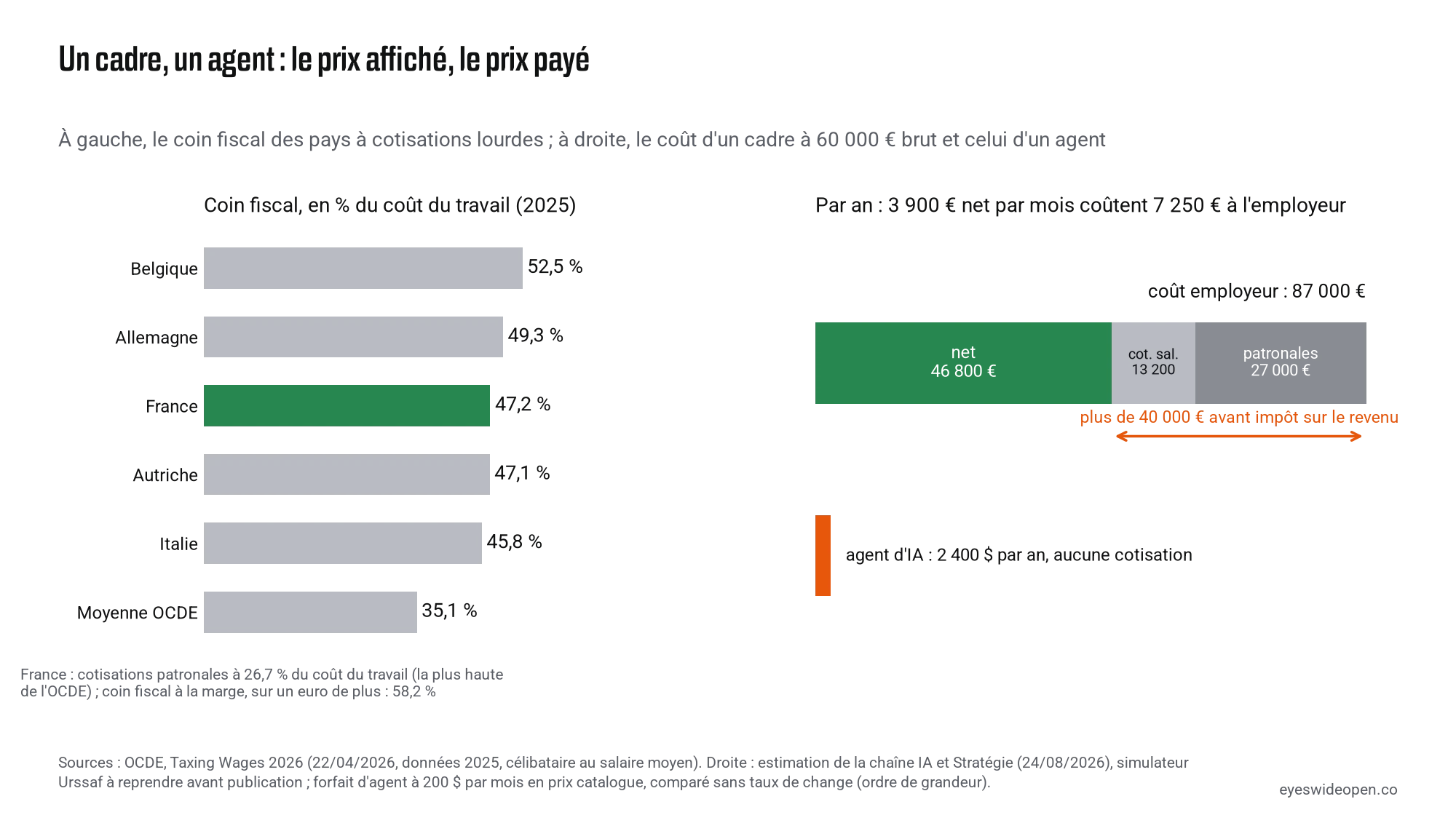

Un cadre, un agent : le prix affiché, le prix payé. Coin fiscal OCDE et coût comparé.
Traduction : à productivité égale, chaque tâche transférée d’un humain vers une machine rapporte plus à une entreprise française qu’à une entreprise américaine, parce qu’elle échappe à un prélèvement plus lourd. Et comme les allègements de charges (environ 77 milliards d’euros en 2024, selon la Cour des comptes16) se concentrent au niveau du SMIC, l’écart est maximal précisément sur le travail qualifié, celui que l’IA sait de mieux en mieux faire. Les économistes Daron Acemoglu et Pascual Restrepo ont décrit le même biais aux États-Unis : le travail y est taxé bien plus lourdement que les logiciels et l’équipement.17
On a construit un système où l’on paie la Sécurité sociale en embauchant, et où l’on économise en la quittant. Difficile de faire plus pédagogique comme incitation à la désertion.
†coin fiscal : écart entre ce que coûte un salarié à son employeur et ce qu’il touche réellement, une fois déduits cotisations et impôt sur le revenu. S’exprime en % du coût total du travail.
4. Le dernier acte de Bismarck
Et c’est là qu’on arrive au cœur du sujet, celui qui dépasse de loin Microsoft, les développeurs et même l’IA.
Le salariat est jeune. Au milieu des années 1950, plus d’un tiers des Français en emploi n’étaient pas salariés : paysans, artisans, commerçants. En une génération, la proportion s’est inversée ; aujourd’hui, 86,5 % des personnes en emploi sont salariées.18 Le sociologue Robert Castel a raconté cette « société salariale » : le salaire n’est pas seulement une rémunération, c’est le support d’une « propriété sociale », retraite, assurance maladie, chômage, crédit, logement… tout ce qui permet à quelqu’un qui ne possède rien d’avoir quand même un avenir.
Et derrière cette société, il y a une invention fiscale de génie. En 1883, Bismarck crée l’assurance maladie obligatoire financée par des cotisations sur les salaires. Le salaire est l’assiette rêvée de tout État :
- Il est déclaré par un tiers, l’employeur.
- Il est immobile : on ne délocalise pas un salarié dans un paradis fiscal.
- Il est mesuré au centime, tous les mois.
Pendant cent quarante ans, c’est là-dessus qu’on a construit la protection sociale.
Seulement voilà : une assiette fiscale ne vaut que tant que la richesse y passe. Aux États-Unis, la part du revenu du secteur marchand qui revient au travail est tombée à 52,8 % au deuxième trimestre 2026. C’est le plus bas niveau depuis le début de la série, en 1947.19 Le reste va au capital, aux marges… et, de plus en plus, aux fournisseurs de calcul. En France, la bascule a déjà commencé, sans qu’on la nomme. Les cotisations représentaient environ 80 % des ressources de la protection sociale en 1990. Elles n’en représentent plus que 55,6 % en 2024.20 La CSG, créée en 1991, a pris le relais.
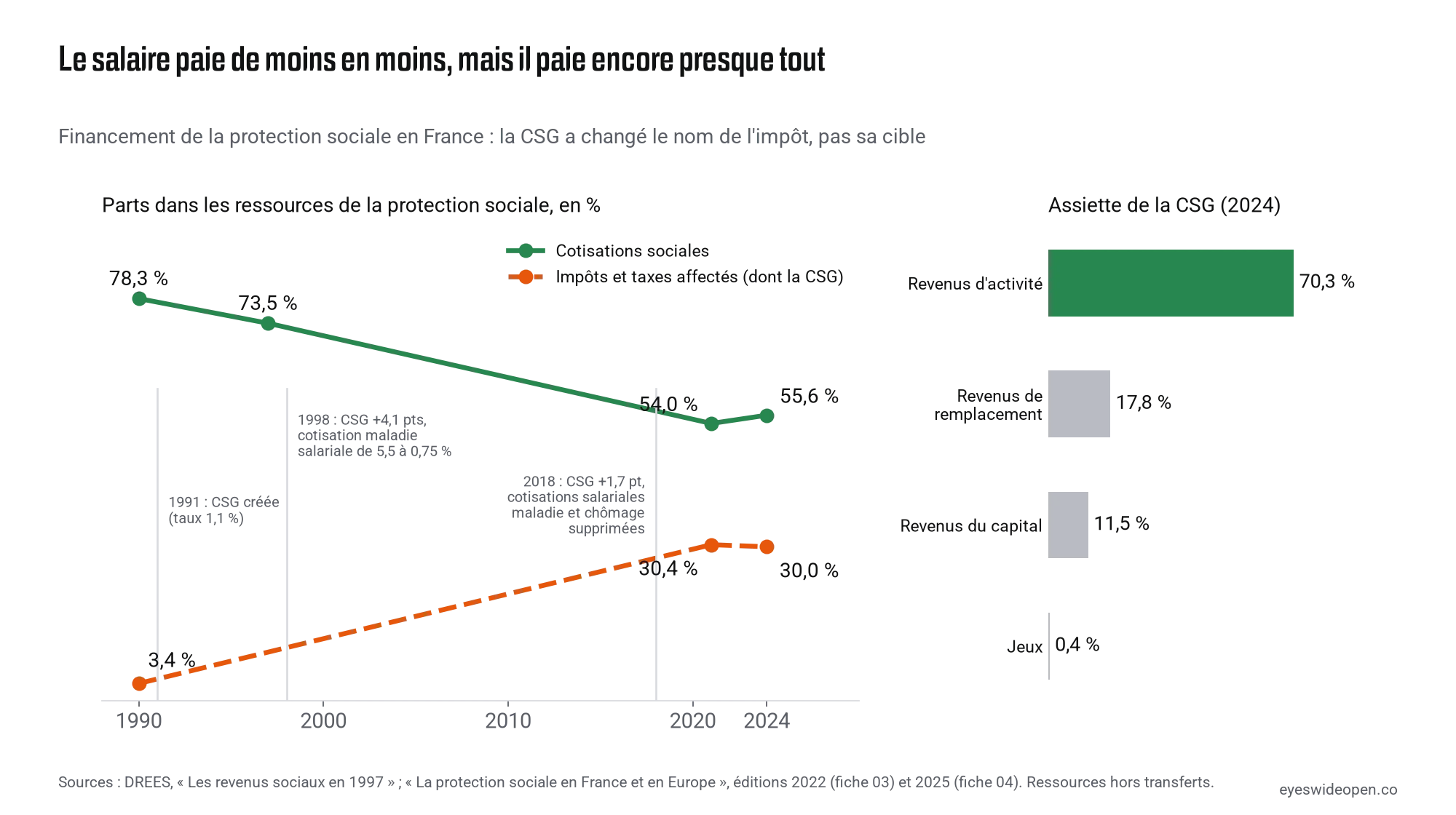
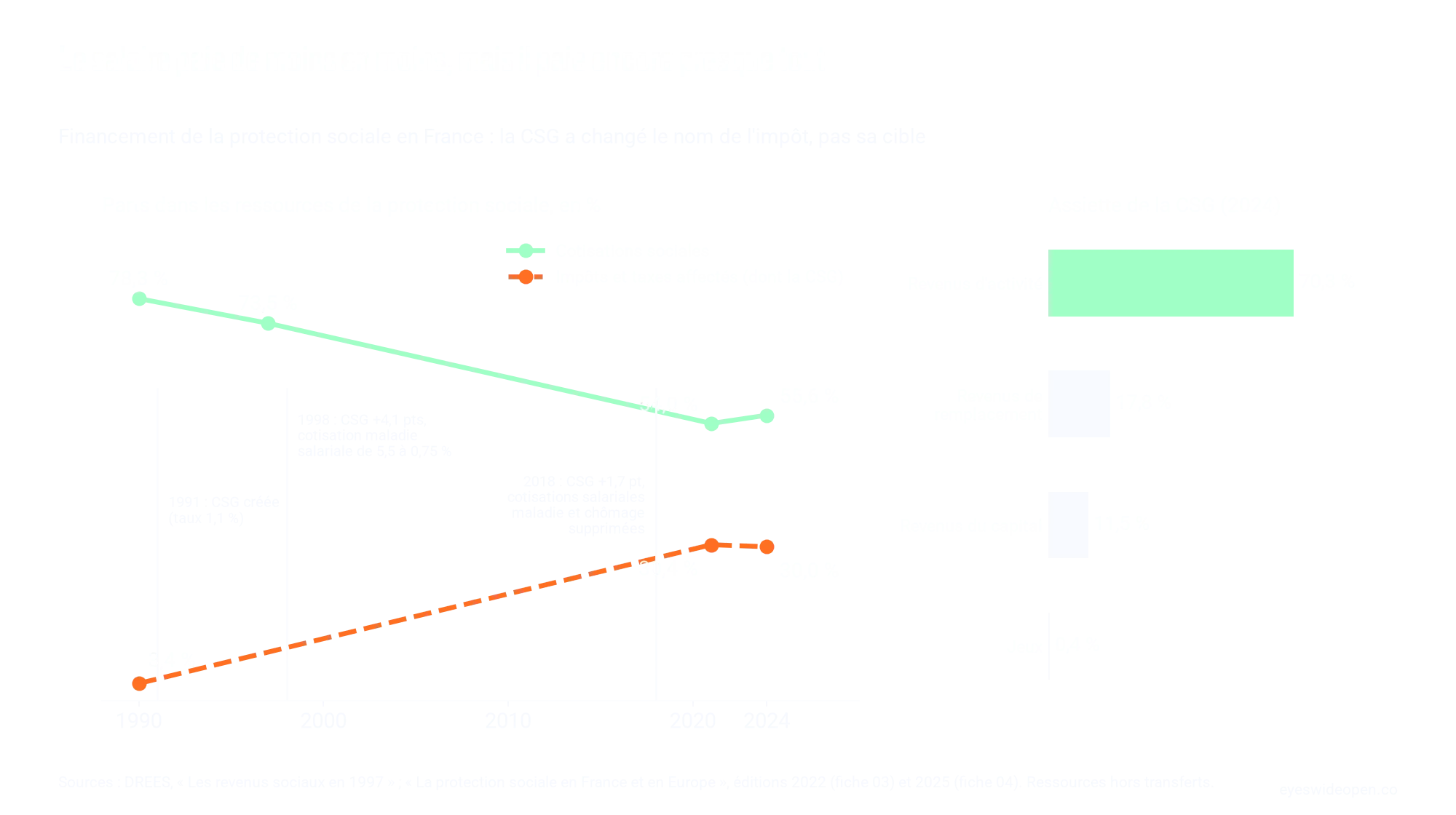
Le salaire paie de moins en moins, mais il paie encore presque tout. Financement de la protection sociale en France.
Je vous dois une nuance, et elle est de taille : 70,3 % de la CSG porte encore sur les revenus d’activité.20 Autrement dit, on a changé le nom de l’impôt, pas sa cible. Le salaire reste, de loin, ce qui finance notre modèle social. C’est justement ce qui le rend fragile. On a construit une maison sur un seul pilier, et ce pilier est en train de se fissurer exactement au moment où on en a le plus besoin, avec une population qui vieillit.
On a déjà vécu ça avec l’impôt sur les sociétés. Quand le capital est devenu mobile, les États se sont fait concurrence pour l’attirer, et les taux ont fondu pendant trente ans. Le salaire, lui, était l’assiette qui ne bougeait pas. Elle vient de se mettre à bouger. Un euro de salaire remplacé par un euro d’abonnement ne disparaît pas : il émigre. Hier il payait la retraite d’un Français, aujourd’hui il paie le data center d’un fournisseur américain, et il sort de l’assiette comme du pays d’un seul geste.
5. Le travail ne disparaît pas, il change de contrat
Alors, la fin du travail ? Non. Et c’est la partie la plus intéressante.
Le métier qui monte le plus vite dans l’IA, ce n’est pas « prompt engineer », mort-né en deux ans. C’est le forward deployed engineer†, un ingénieur qui vit chez le client, adapte les modèles à son métier et porte la responsabilité du résultat. Aux États-Unis, les offres sont passées d’environ 643 à 5 330 en un an, selon Indeed.21 Ce métier dit tout de la nouvelle économie : la valeur n’est plus dans le modèle, que tout le monde peut louer, mais dans le dernier kilomètre, celui qui fait passer un système de 80 % à 99 % de fiabilité dans le monde réel d’un client. Et ce dernier kilomètre se vend… à la mission. Anthropic, d’ailleurs, vend à la fois le substitut et l’intégrateur, avec une coentreprise de services valorisée environ 1,5 milliard de dollars selon le Wall Street Journal, montée en mai avec Blackstone, Hellman & Friedman et Goldman Sachs : on y revient dans notre thèse sur son introduction en Bourse.
C’est là que le vieux théorème de Ronald Coase revient. En 1937, Coase se demandait pourquoi les entreprises existent, au lieu que tout le monde contracte au marché. Sa réponse : parce qu’il coûte moins cher de coordonner des gens en interne que de négocier chaque tâche à l’extérieur. Le salariat, au fond, c’est le régime juridique de l’intérieur de la firme. Or l’IA fait baisser les deux coûts à la fois, celui d’organiser en interne et celui de contracter à l’extérieur. Résultat : la taille efficace d’une entreprise baisse. Block réduit de 40 %.
Et le travail qui reste prend la forme de missions, de contrats de service, de micro-entreprises. En France, on compte 3,03 millions de micro-entrepreneurs, un record, dont deux millions environ ont une activité réelle.22 Mais attention au conte de fées. Sur le papier, trois millions de patrons. Dans les faits, parmi ceux qui dégagent un revenu, un sur deux touchait moins de 340 euros par mois en 2023 : on a rebaptisé le temps partiel subi « liberté ».
†forward deployed engineer (FDE) : ingénieur « déployé en avant », qui travaille sur site chez le client pour adapter un produit complexe à son métier. Le modèle vient de Palantir, qui appelle ces profils des « Deltas ».
6. Mon pari : l’abonnement remplace le salarié, et personne n’a de guichet pour ça
Je dois d’abord vous présenter le meilleur argument contre tout ce qui précède, parce qu’il est solide. Les agrégats ne bougent pas : le chômage américain baisse, les suppressions annoncées sont même en recul de 41 % sur les huit premiers mois de 2026 selon Challenger (l’année 2025 avait été gonflée par les coupes du secteur public), et la part des salaires dans la valeur ajoutée des entreprises françaises est revenue à son niveau de 2015.23 Chaque vague technologique a d’abord détruit des tâches avant de créer des métiers, et Indeed observe que la relation entre exposition à l’IA et offres d’emploi commence à s’inverser. Un économiste prudent dirait : attendons.
Je ne suis pas un économiste prudent. Les agrégats mesurent des stocks, et ma thèse porte sur des flux : les embauches de juniors, les postes non créés, l’assiette qui s’érode, la part du revenu qui change de poche. Or tous les indicateurs de flux vont dans le même sens. Alors voici ce que je pense vraiment, sans filet : nous entrons dans une économie où l’abonnement à l’IA et la facturation au token† remplacent peu à peu l’employé comme unité de production. Pas partout, pas demain matin, pas sans accidents. Mais à la marge, tâche après tâche, la ligne « salaires » du compte de résultat va céder du terrain à la ligne « abonnements ». Et ce que je trouve fascinant, c’est que nos systèmes n’ont pas prévu cette ligne. Ni nos administrations fiscales, ni le patronat, ni nos retraites, ni même notre démographie.
L’administration fiscale n’a pas de case pour ça. Comment prélever des charges salariales sur ChatGPT ? Elle n’a ni fiche de paie, ni numéro de Sécurité sociale, ni CSE, ni mal de dos. Elle ne tombe pas malade, ne fait pas grève, et ne rend jamais visite à l’Urssaf. Le droit français sait requalifier un livreur en salarié ; personne n’a encore essayé avec une API. Alors, va-t-on instaurer une taxe sur l’inférence‡, et si oui comment ? Il n’existe que trois réponses, et aucune n’est propre. Monter les cotisations sur les salariés qui restent, c’est élargir le coin fiscal, donc rendre la substitution encore plus rentable : on serre la vis, ça fuit plus vite. Taxer la machine, c’est le vieux fantasme de la taxe robot : Benoît Hamon en a fait un pilier de sa campagne de 2017, terminé à 6,36 % au premier tour, et le Parlement européen l’a enterrée la même année ; Bill Gates l’avait pourtant défendue.24 Changer d’assiette, enfin, financer la protection par la consommation ou le revenu entier : c’est mathématiquement la seule issue, et politiquement de la nitroglycérine, parce que ça revient à avouer que le salaire ne porte plus le modèle.
Je crois pourtant qu’il existe une quatrième voie, qui me paraît moins absurde que les trois autres : prélever à la source de la facture. La TVA sait déjà le faire : quand une entreprise française achète un service à un prestataire étranger, elle l’autoliquide§, c’est-à-dire qu’elle déclare elle-même la taxe due.40 Une contribution à faible taux sur les factures d’inférence passerait par le même tuyau, avec une assiette large (tous les tokens, pas seulement ceux qui remplacent un humain, ce qu’aucun contrôleur ne saura jamais distinguer d’un abonnement à Zoom). C’est la logique du projet de loi déposé en août aux États-Unis par trois élus démocrates : une taxe d’accise de 2 à 3 % sur la valeur des tokens ou le chiffre d’affaires IA.25 Dario Amodei lui-même, patron du fournisseur, a évoqué le 10 juin des taxes sur les « entreprises concernées » ou sur les plus-values pour financer un revenu de base.26 Que le vendeur de la pelle demande qui paiera les trous, c’est assez rare pour être noté.
Et puis il y a le piège : une taxe française sur l’inférence est, de fait, la plus puissante politique industrielle jamais menée en faveur des modèles ouverts. Si tout est taxé à la facture, la parade s’appelle l’auto-hébergement : on fait tourner un modèle open weight‖ sur ses propres serveurs, plus de facture, plus d’assiette. Et si l’on taxe plutôt l’électricité ou la capacité de calcul, on taxe le pays qui héberge le data center, pas celui qui consomme : l’Irlande ou la Virginie, pas la France. On avait déjà joué cette pièce avec la taxe sur les services numériques de 2019 : 3 % sur le chiffre d’affaires des géants, et les droits de douane américains qui menacent aussitôt.27 Le jour où le Premier ministre dira « faire contribuer l’intelligence artificielle au financement de notre modèle social », ce sera le signal que la fenêtre de substitution se referme pour les entreprises. J’ai du mal à croire qu’il le dise avant qu’un rapport officiel ait chiffré le trou.
Le patronat va réclamer l’inverse. Je ne dis pas qu’il se trompe : je dis qu’il n’a aucun intérêt à demander une taxe sur ce qui lui coûte moins cher que ses salariés, et tout intérêt à demander de nouveaux allègements, qui coûtent déjà 77 milliards d’euros par an. Le système fabrique d’ailleurs ses propres absurdités. La participation, cette part des bénéfices que les entreprises d’au moins 50 salariés (pendant cinq années consécutives) doivent redistribuer, se calcule avec la masse salariale dans la formule.28 Remplacez des salariés par des abonnements, vos bénéfices montent, la masse salariale baisse : la prime des salariés restants peut fondre au moment où l’entreprise s’enrichit. Et le seuil des 50 salariés, déjà celui qu’on évite de franchir, devient celui qu’on ne franchira jamais : on peut désormais croître en chiffre d’affaires sans embaucher.
La démographie, enfin, et là je prends un risque. En 2025, la France a compté 645 000 naissances et 651 000 décès : pour la première fois depuis 1945, le solde naturel est négatif, avec une fécondité estimée à 1,56 enfant par femme.29 Le Conseil d’orientation des retraites vient de relever sa prévision de déficit à long terme (2,4 % du PIB en 2070, contre 1,4 % dans le rapport précédent) en partant d’une fécondité de 1,45 à partir de 2028.30 Tout le monde en conclut : catastrophe, moins de cotisants. Et si c’était, en partie, l’inverse ? Je ne dis pas que c’est une bonne nouvelle : je dis que c’est peut-être la première fois qu’on fabrique moins de salariés au moment précis où l’on invente de quoi s’en passer, et qu’à ce rythme, la démographie risque de devenir un problème de répartition bien plus qu’un problème de main-d’œuvre. Le vrai problème, c’est que la répartition ne marche que si la valeur passe par la fiche de paie. J’ose le dire : un système de retraite par répartition conçu pour des cotisants rares et productifs est intenable avec des cotisants remplacés par des abonnements, quelle que soit la courbe des naissances. Ce n’est pas un fait, c’est ma projection, et je la donne comme telle.
Reste le surplus. Si la valeur ne passe plus par les salaires, où va-t-elle ? Aux marges des entreprises, aux fournisseurs de calcul, aux actionnaires. Un surplus de numéraire sans destinataire. Trois pistes, du plus audacieux au plus concret :
- Un revenu universel financé sur ce surplus : Sam Altman en proposait déjà le principe en 2021 (« Moore’s Law for Everything », un fonds alimenté par une taxe payée en actions par les grandes entreprises),31 et l’expérience OpenResearch (1 000 dollars par mois pendant trois ans) a montré que l’argent aide, mais que les bénéficiaires travaillent aussi un peu moins, environ 1,3 heure par semaine.32
- Une rémunération directe sur le capital : quand la valeur part au capital, ceux qui le peuvent réclament d’être payés comme le capital. C’est ce que font déjà les ouvriers coréens, comme on le voit dans notre thèse sur la mémoire, où Samsung cède 10,5 % du résultat de sa division puces et où le syndicat de Hyundai a réclamé 30 % du bénéfice net avant de signer, fin août, une prime forfaitaire.
- Et une répartition qui ne passe plus par l’employeur : droits attachés à la personne, financement par l’impôt, à la danoise.
Franchement, je ne sais pas laquelle de ces pistes l’emportera. Je suis certain, en revanche, que la question est posée trop tard, et trop bas. Voilà ce que je parie, avec les réserves qui vont avec :
- D’ici six mois, au moins deux autres géants de la tech annonceront des plans de départs ou de suppressions d’au moins 5 % de leurs effectifs en invoquant l’IA ou le coût de leurs investissements, et le bilan annuel de Challenger, en janvier, confirmera l’IA comme premier motif de l’année.
- D’ici deux ans, un rapport officiel (Haut Conseil du financement de la protection sociale, Cour des comptes ou mission parlementaire) chiffrera pour la première fois l’effet de l’IA sur l’assiette des cotisations, et l’expression « contribution de l’IA » apparaîtra dans un projet de loi de financement de la Sécurité sociale.
- D’ici dix ans, au moins un pays de l’OCDE taxera les tokens ou le calcul pour financer sa protection sociale. Je ne parierais pas ma chemise sur le seuil de 50 % pour les cotisations : la DREES les voit quasi stables depuis 2019, et 13 % d’entre elles sont de simples écritures comptables de l’État employeur.
†token : unité de découpage du texte traitée par un modèle (un mot ou un morceau de mot). Les fournisseurs d’IA facturent à la consommation, par million de tokens lus et écrits.
‡inférence : le fait de faire tourner un modèle d’IA pour obtenir une réponse (par opposition à l'« entraînement », qui le fabrique). C’est ce que facture un abonnement ou une API, au forfait ou au token.
§autoliquidation : mécanisme de TVA où c’est le client, et non le fournisseur étranger, qui calcule et déclare la taxe due sur l’achat. Il permet de retrouver, dans la déclaration du client, des factures émises depuis l’étranger.
‖open weight : modèle dont les « poids » (les paramètres appris) sont publiés et téléchargeables, donc exécutable sur ses propres machines, sans passer par l’API d’un fournisseur.
7. Que faire à la place
Démonter un modèle n’a de sens que si l’on dit par quoi le remplacer. Mais je ne vais pas jouer au gourou : voici, à ce stade, ce que je pense vraiment, et ce que je ferais à votre place.
Je crois qu’on se dirige vers une société où le travail se réorganise autour de solopreneurs† précaires, une sorte d’Uber ou de Deliveroo du travail cognitif : des missions, une plateforme ou un client qui paie à la tâche, et personne pour cotiser à votre place. L’Union européenne a adopté en 2024 une directive sur le travail de plateforme, qui crée une présomption de salariat, à transposer au plus tard le 2 décembre 2026. La France n’avait pas déposé de projet de loi en juillet.33 Et c’est une directive écrite pour des livreurs, pas pour des consultants.
Et quand tout le monde se met à son compte avec le même outil, devinez ce qui sort : du contenu. Énormément de contenu. De la bouillie, pour tout dire. Merriam-Webster a fait de « slop » son mot de l’année 2025, et Kapwing a compté 21 % de vidéos générées par IA parmi les 500 premiers Shorts proposés à un compte YouTube neuf.34 Je m’attends à une explosion de contenus AI slop‡, et à un solopreneur qui se bat contre ses propres outils : quand le coût de production d’un contenu tombe à zéro, son prix suit.
Alors, que faire ?
- Connaître son prix de marché à froid : une offre extérieure, ou un premier client payant, par an. Ça ne va pas être un exercice agréable, mais c’est à vous de faire cette introspection, ou non. Ce n’est pas une question de partir : c’est une question de savoir ce que l’on vaut hors de son employeur, parce que la sécurité du CDI repose désormais sur une promesse de marge.
- Se réorienter, plus tôt que prévu. Je pense que beaucoup d’entre nous devront changer de voie, et que ce n’est pas un échec. Monter vers ce qui se signe : l’évaluation, l’audit, la mise en production, la relation client. Tout ce où il faut quelqu’un qui met son nom sur le résultat. Et ne pas faire porter au foyer deux revenus exposés au même choc.
- Garder un œil sur les retours en arrière. C’est le contre-courant que je trouve le plus rassurant : le tout-IA est encore trop immature, et l’humain reste indispensable aujourd’hui. Quelques exemples, datés :
- Klarna avait annoncé en 2024 que son IA faisait le travail de 700 agents. En mai 2025, son patron a reconnu que le coût avait été un critère trop dominant au détriment de la qualité, et la société a rouvert des postes humains.35
- Commonwealth Bank of Australia a annulé en août 2025 la suppression de 45 postes de service client, après avoir remplacé ces agents par un robot vocal, et reconnu une erreur d’appréciation ; selon le syndicat, les appels ne baissaient pas, ils augmentaient.36
- Gartner, dans une enquête d’octobre 2025 auprès de 321 responsables du service client, ne trouve que 20 % d’entre eux ayant réduit leurs effectifs à cause de l’IA, et prévoit que la moitié des entreprises qui l’ont fait réembaucheront d’ici 2027.37
- Orgvue, en début 2025, relevait que 55 % des dirigeants ayant supprimé des postes à cause de l’IA jugeaient avoir pris la mauvaise décision.38
Je dois nuancer : Forrester prévoit que la moitié des suppressions attribuées à l’IA seront « discrètement inversées », mais avec des postes qui reviennent à l’étranger ou à des salaires plus bas.39 Un retour en arrière n’est pas un retour au statu quo.
Si je devais résumer : en 1883, Bismarck n’a pas inventé la solidarité, il a trouvé où se cachait l’argent, dans l’enveloppe de paie que l’employeur remettait lui-même au percepteur. Cent quarante ans plus tard, l’argent est parti dans une facture mensuelle payée à un serveur de Virginie, et l’État cherche encore l’enveloppe.
†solopreneur : travailleur indépendant seul, sans salarié, qui vend ses services (ou ses contenus) en ligne à plusieurs clients, souvent via des plateformes.
‡AI slop : « bouillie » de contenus de basse qualité produits en masse par IA. Merriam-Webster le définit comme du « contenu numérique de basse qualité, produit généralement en quantité au moyen de l’intelligence artificielle ».
Sources
- Bloomberg, « Microsoft to offer buyouts to 60,000 workers in latest cost cut », 26/10/2026 (https://www.bloomberg.com/news/articles/2026-10-26/microsoft-to-offer-buyouts-to-60-000-workers-in-latest-cost-cut) ; Microsoft, « Introducing a Voluntary Exit Offer », billet signé Amy Coleman, 26/10/2026 (https://blogs.microsoft.com/blog/2026/10/26/introducing-a-voluntary-exit-offer/) : offre ouverte aux États-Unis, au Canada, en Inde et au Royaume-Uni, hors Union européenne ; Microsoft ne publie aucun nombre. Un porte-parole a indiqué à Business Insider que plus d’un quart de l’effectif est éligible. Les 60 000 et l’échéance de début décembre viennent de la presse.
- Microsoft, communiqué de résultats de l’exercice 2026 clos le 30/06/2026, 29/07/2026 (chiffre d’affaires 331,8 Md$, +18 % ; https://news.microsoft.com/source/2026/07/29/microsoft-cloud-and-ai-strength-fuels-fourth-quarter-results-4) ; résultats du premier trimestre de l’exercice 2027, 28/10/2026 (Azure +48 %, relayés par la presse : https://aiweekly.co/alerts/microsoft-q1-revenue-hits-923b-azure-up-48-as-capex-jumps-to-394b-with-175b).
- Bureau of Labor Statistics (BLS), « The Employment Situation, September 2026 », 02/10/2026 (https://www.bls.gov/news.release/archives/empsit_10022026.htm).
- Federal Reserve Bank of New York, « The Labor Market for Recent College Graduates », T3 2026 (https://www.newyorkfed.org/research/college-labor-market) : chômage des jeunes diplômés de 5,2 % (le plus bas niveau en plus d’un an), sous-emploi de 42,5 %. Le 4,2 % de l’ensemble des actifs vient de la note 3.
- Erik Brynjolfsson, Bharat Chandar et Ruyu Chen, « Canaries in the Coal Mine ? Six Facts about the Recent Employment Effects of Artificial Intelligence », Stanford Digital Economy Lab, version révisée du 12/08/2026 (https://digitaleconomy.stanford.edu/publications/canaries-in-the-coal-mine/) ; version initiale d’août 2025 : −13 % (connu, non relu ce jour).
- Indeed Hiring Lab, « AI and Job Postings : From Destruction to Creation ? », 08/07/2026 (https://hiringlab.indeed.com/2026/07/08/ai-and-job-postings-from-destruction-to-creation/) : 71 % de la hausse des offres de développeurs entre mai 2025 et mai 2026 vient de postes seniors.
- Dares, ruptures conventionnelles individuelles : environ 515 000 en 2024, d’après le rapport de la commission des affaires sociales de l’Assemblée nationale (https://www.assemblee-nationale.fr/dyn/17/rapports/cion-soc/l17b2633_rapport-fond.pdf), janvier 2026.
- Microsoft, communiqué du 29/07/2026 (chiffre d’affaires 331,8 Md$ +18 % ; résultat opérationnel 155,2 Md$ +21 % ; résultat net 133,7 Md$ +31 %, dont 4,963 Md$ de gains nets sur les investissements dans OpenAI) ; effectifs d’environ 223 000 au 30/06/2026 contre 228 000 un an plus tôt, relayés du rapport annuel 10-K par la presse (non relus à la source) ; investissements du premier trimestre de l’exercice 2027 d’environ 39,4 Md$ (source unique de presse, à confirmer).
- Rob Enderle (Enderle Group), KRON4, 05/05/2026, à propos de Coinbase et Meta (« It’s the cost of AI that’s causing the income statements to get out of whack », traduit de l’anglais).
- Block, annonce du 26/02/2026 ; Jack Dorsey sur X (« smaller and flatter teams ») ; The Spokesman-Review, 27/02/2026 (https://www.spokesman.com/stories/2026/feb/27/block-to-cut-more-than-4000-jobs-amid-ai-disruptio).
- Challenger, Gray & Christmas, rapports mensuels de 2026 (par exemple août : https://www.challengergray.com/wp-content/uploads/2026/09/Challenger-Report-August-2026.pdf, publié le 03/09/2026) ; septembre (120 136, 21 % du total) : rapport du 01/10/2026 relayé par la presse ; total 2025 de 54 836 relayé par aiunderstanding.org. Janvier, août et septembre du graphique sont des différences de cumuls publiés.
- Andy Jassy, appel sur les résultats du troisième trimestre d’Amazon, 30/10/2025 : les 14 000 suppressions de postes sont « not really financially driven, and it’s not even really AI-driven, not right now, at least. Really, it’s culture » (https://www.techradar.com/pro/amazon-ceo-says-recent-mass-layoffs-were-due-to-culture-and-removing-layers-not-ai).
- IA et Stratégie, « L’effondrement du modèle salarial », vidéo YouTube du 24/08/2026 (https://www.youtube.com/watch?v=svIm_UPIbNo). Les chiffres de coût d’un cadre (87 000 € pour 60 000 € brut et 46 800 € net) en viennent ; ce sont des ordres de grandeur cohérents mais à recalculer sur https://mon-entreprise.urssaf.fr/simulateurs/salaire-brut-net.
- METR, « Measuring the impact of early-2025 AI on experienced open-source developer productivity », 10/07/2025 (https://metr.org/blog/2025-07-10-early-2025-ai-experienced-os-dev-study/).
- OCDE, Taxing Wages 2026 (publié le 22/04/2026, données 2025, célibataire sans enfant au salaire moyen) : Belgique 52,5 %, Allemagne 49,3 %, France 47,2 %, moyenne OCDE 35,1 % ; cotisations patronales françaises à 26,7 % du coût du travail, le plus haut niveau de l’OCDE (note pays France, https://www.oecd.org/content/dam/oecd/en/publications/reports/2026/04/taxing-wages-2026-country-notes_491a0e97/france_e4ab8466/7d4e9727-en.pdf ; brochure Taxing Wages 2026, https://www.oecd.org/content/dam/oecd/en/topics/policy-issues/tax-policy/taxing-wages-brochure.pdf). La Tax Foundation donne 44,6 % pour la France avec une méthode différente.
- Cour des comptes, rapport sur l’application des lois de financement de la sécurité sociale, mai 2025 (https://www.ccomptes.fr/sites/default/files/2025-05/20250526-RALFSS-2025-Maitriser-dynamique-allegements-generaux-de-cotisations-sociales.pdf) : le coût des allègements généraux du secteur privé est passé d’environ 20,9 Md€ en 2014 à 77,3 Md€ en 2024 (coût brut).
- Daron Acemoglu, Andrea Manera et Pascual Restrepo, « Does the U.S. Tax Code Favor Automation ? », Brookings Papers on Economic Activity, printemps 2020 (https://www.brookings.edu/articles/does-the-u-s-tax-code-favor-automation/) : taux effectif d’environ 28,5 % sur le travail contre environ 5 % sur les équipements et logiciels.
- Insee, enquête Emploi 2025, statuts d’emploi (https://www.insee.fr/fr/statistiques/8733045) ; Conseil d’orientation des retraites, séries sur les non-salariés (plus d’un tiers de l’emploi au milieu des années 1950 ; https://cor-retraites.fr/sites/default/files/2019-06/doc-1760.pdf).
- BLS, « Labor share at its lowest level (52.8 percent) in second quarter 2026 », The Economics Daily, 15/09/2026 (https://www.bls.gov/opub/ted/2026/labor-share-at-its-lowest-level-52-8-percent-in-second-quarter-2026.htm) ; série depuis 1947, 60 à 66 % après-guerre.
- DREES, « La protection sociale en France et en Europe en 2024 », édition 2025, fiche 04 (https://drees.solidarites-sante.gouv.fr/sites/default/files/2025-12/CPS2025%20-%20Fiche%2004%20-%20Le%20financement%20de%20la%20protection%20sociale%20en%202024.pdf) : cotisations 55,6 % des ressources (554,4 Md€), CSG 15,3 %, 70,3 % de la CSG sur les revenus d’activité ; DREES, Études et résultats n° 826, décembre 2012 (https://www.drees.solidarites-sante.gouv.fr/sites/default/files/2020-09/er826.pdf) : environ 80 % en 1990, séries de bases différentes et édition 2022, fiche 03 (54,0 % en 2021).
- Indeed, d’après Business Insider, mai 2026 (https://www.businessinsider.com/forward-deployed-engineer-jobs-in-demand-2026-5, page non accessible à la relecture) : offres de forward deployed engineer aux États-Unis, 643 en avril 2025, 5 330 en avril 2026. Coentreprise d’Anthropic : TechCrunch, 04/05/2026, valorisée environ 1,5 Md$ selon le WSJ, dont 300 M$ d’engagement chacun pour Anthropic, Blackstone et Hellman & Friedman, Goldman Sachs étant partenaire fondateur (https://techcrunch.com/2026/05/04/anthropic-and-openai-are-both-launching-joint-ventures-for-enterprise-ai-services/).
- Urssaf, Stat’ur n° 423, 25/09/2026, via Le Journal des Entreprises (3,03 millions de micro-entrepreneurs fin 2025) ; Insee Première n° 2060, juin 2025 (en 2023, un micro-entrepreneur sur deux, hors revenus nuls, gagne moins de 340 € par mois) et n° 2114, juin 2026 (2,05 millions de micro-entrepreneurs économiquement actifs en 2024 ; revenu moyen de 680 € par mois en 2024).
- Challenger, rapport d’août 2026 : 529 914 suppressions de janvier à août 2026, −41 % par rapport à 892 362 en 2025 (effet des coupes du secteur public américain en 2025 ; −15 % hors secteur public) ; Indeed Hiring Lab, 08/07/2026 ; Insee Première n° 2105, 29/05/2026, taux de marge des sociétés non financières de 32,2 % en 2025, contre 32,0 % en 2015 (https://www.insee.fr/fr/statistiques/8996855).
- Benoît Hamon, 6,36 % au premier tour de la présidentielle de 2017 ; Parlement européen, rapport Delvaux, rejet de la taxe sur les robots, 16/02/2017 (https://europaforum.public.lu/fr/actualites/2017/02/pe-robotique/index.html) ; Bill Gates, entretien à Quartz, 17/02/2017 (« Robots that take jobs from humans should pay taxes », fait connu, non relu ce jour).
- H.R. 10044, « AI Tax and Work Protection Act », déposé le 06/08/2026 par les représentants Greg Casar, Valerie Foushee et Sara Jacobs : taxe d’accise de 2 à 3 % sur la valeur des tokens traités ou le chiffre d’affaires de services d’IA, au plus élevé des deux, produit versé à un fonds fiduciaire pour l’emploi. Source secondaire (https://ai2.work/blog/democrats-ai-token-tax-would-fund-a-new-federal-jobs-program), texte du projet non relu.
- Dario Amodei, essai publié sur son site le 10/06/2026, relayé par Fortune (https://fortune.com/2026/06/11/anthropic-dario-amodei-ai-jobs-tax-displacement-fund/) : un revenu de base pourrait être envisagé en cas de baisse durable de la demande de travail, financé par des taxes sur les « relevant companies » ou une hausse de l’impôt sur les plus-values ; Bloomberg Law, « Anthropic CEO Floats Tax on AI Firms to Fund Universal Income ».
- Loi du 24/07/2019 créant la taxe sur les services numériques (3 % du chiffre d’affaires, seuils de 750 M€ dans le monde et 25 M€ en France ; https://www.legifiscal.fr/impots-taxes-entreprise/autres-impots-taxes/taxe-services-numeriques.html) ; l’USTR américain a proposé fin 2019 des droits de douane jusqu’à 100 % sur environ 2,4 Md$ de produits français ; en juin 2026, Donald Trump menace à nouveau les pays européens de droits de 100 % (Euronews, 26/06/2026, https://fr.euronews.com/2026/06/26/taxe-services-numeriques-trump-menace-dimposer-des-droits-de-douane-de-100-aux-pays-de-lue).
- Code du travail, article L3324–1 : la réserve spéciale de participation se calcule avec la formule 1/2 (B — 5 % C) x S/VA, où S est la masse salariale et VA la valeur ajoutée (https://entreprendre.service-public.gouv.fr/vosdroits/F2141 ; texte de loi : https://www.legifrance.gouv.fr/codes/id/LEGIARTI000006903016/2026-08-06). Raisonnement de la vidéo d’IA et Stratégie du 24/08/2026.
- Insee, « Bilan démographique 2025 », Insee Première n° 2087, janvier 2026 : 645 000 naissances (-2,1 % sur un an), 651 000 décès, solde naturel négatif pour la première fois depuis 1945, indicateur conjoncturel de fécondité de 1,56 enfant par femme (https://www.insee.fr/fr/statistiques/8719824).
- Conseil d’orientation des retraites, rapport annuel, 11/06/2026 (https://www.cor-retraites.fr/rapports-du-cor/rapport-annuel-cor-juin-2026-evolutions-perspectives-retraites-france) : nouvelles hypothèses démographiques de l’Insee (fécondité de 1,45 à partir de 2028) ; déficit de 0,2 % du PIB en 2030, 0,9 % en 2045 et 2,4 % en 2070 contre 1,4 % dans le rapport précédent, d’après la synthèse de Groupama relayée par la presse (non relu dans le rapport).
- Sam Altman, « Moore’s Law for Everything », 16/03/2021 (https://moores.samaltman.com/) : proposition d’un « American Equity Fund » alimenté par une taxe annuelle payée en actions par les grandes entreprises et sur les terres.
- OpenResearch Unconditional Cash Study, 2024 : environ 1 000 bénéficiaires à 1 000 $ par mois pendant trois ans (nov. 2020 à oct. 2023) contre un groupe témoin à 50 $ ; bénéficiaires travaillant environ 1,3 heure de moins par semaine (résultats relayés par la presse, étude de Vivalt et coauteurs non relue).
- Directive (UE) 2024/2831 du 23/10/2024 relative à l’amélioration des conditions de travail dans le cadre du travail via une plateforme, transposition au plus tard le 02/12/2026 ; en France, question écrite de juillet 2026 notant l’absence de projet de loi gouvernemental (https://www.assemblee-nationale.fr/dyn/17/questions/QANR5L17QE14781), proposition de loi au Sénat déposée le 24/07/2026.
- Merriam-Webster, « 2025 Word of the Year : Slop » (https://www.merriam-webster.com/wordplay/word-of-the-year), 15/12/2025 ; Kapwing, « AI Slop Report », novembre 2025 : sur les 500 premiers Shorts d’un compte neuf, 104 (21 %) générés par IA et 165 (33 %) classés « brainrot » (test sur un seul compte, relayé par https://www.techspot.com/news/110735-over-21-youtube-now-ai-slop-report.html).
- Bloomberg, 08/05/2025, relayé par Entrepreneur (https://www.entrepreneur.com/business-news/klarna-ceo-reverses-course-by-hiring-more-humans-not-ai/491396) : Sebastian Siemiatkowski reconnaît que le coût était un critère « too predominant » ; annonce de février 2024 : l’IA fait le travail de 700 agents. Klarna ne renonce pas à l’IA et vise un modèle mixte.
- Bloomberg, 21/08/2025 (https://www.bloomberg.com/news/articles/2025-08-21/commonwealth-bank-reverses-job-cuts-decision-over-ai-chatbots) ; Finance Sector Union, contestation devant le tribunal des relations de travail : la banque affirmait que le robot vocal réduisait les appels de 2 000 par semaine, les syndicats constataient l’inverse ; la date exacte (13 ou 21 août) varie selon les sources.
- Gartner, enquête auprès de 321 responsables du service client, octobre 2025 (communiqué du 02/12/2025 : https://www.gartner.com/en/newsroom/press-releases/2025-12-02-gartner-survey-finds-only-20-percent-of-customer-service-leaders-report-ai-driven-headcount-reduction) ; prévision de réembauche de la moitié des entreprises d’ici 2027 : communiqué du 03/02/2026. C’est une prévision, pas un constat.
- Orgvue, enquête auprès d’environ 1 000 dirigeants, février-mars 2025 (https://www.orgvue.com/news/55-of-businesses-admit-wrong-decisions-in-making-employees-redundant-when-bringing-ai-into-the-workforce/) : parmi les 39 % de dirigeants ayant supprimé des postes à cause de l’IA, 55 % estiment avoir pris la mauvaise décision.
- Forrester, « Predictions 2026 : The Future of Work », octobre 2025 (https://www.theregister.com/2025/10/29/forrester_ai_rehiring) : « We expect half of AI-attributed layoffs to be quietly reversed, with jobs returning offshore or at lower wages ». Prévision, pas constat.
- Code général des impôts, article 283–2 : le preneur assujetti redevable de la TVA sur un service rendu par un prestataire établi hors de France (fait connu, à recouper dans le texte avant publication).