HUMANITY
L’IA ne vous remplacera pas. Elle vous gardera pour signer.
L’IA ne se contente plus de répondre : elle propose, et nous validons. Chaque « oui » est rationnel. C’est exactement ce qui le rend dangereux, pour nos compétences, notre liberté et notre portefeuille.

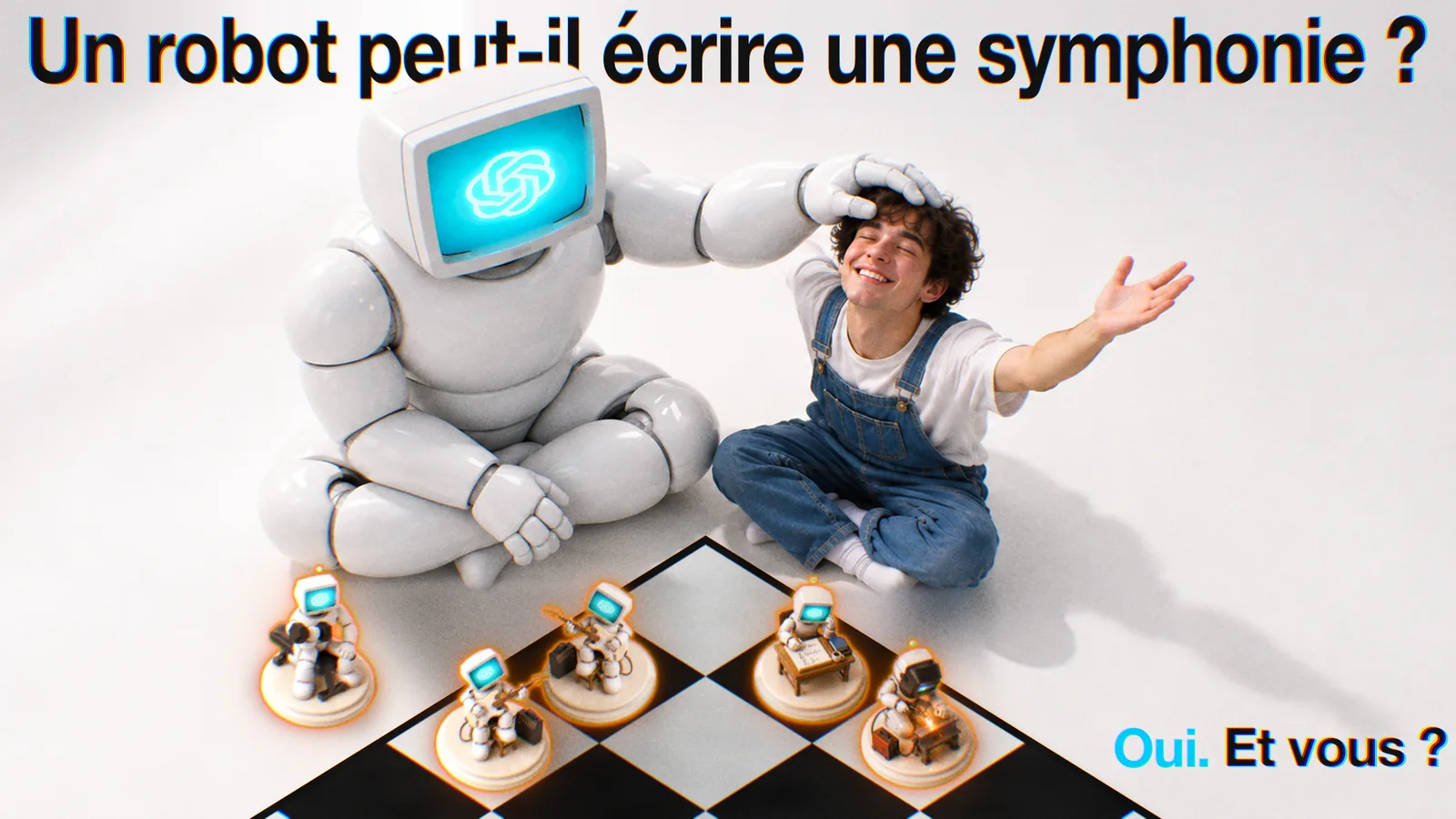
Mercredi 28 octobre 2026. Pour la première fois, ChatGPT peut vous envoyer un SMS. Pas pour vous répondre : de lui-même. Les « dots », ces agents† qu’OpenAI a lancés fin septembre pour ses abonnés Pro, travaillent en tâche de fond entre deux conversations, relisent ce qu’ils savent de vous, et viennent maintenant frapper à la porte pour vous dire ce qu’ils ont fait… et ce qu’ils proposent de faire ensuite. Un lien, un bouton, « valider ».1
Sur les réseaux, le débat est déjà rangé dans deux tiroirs. D’un côté, l’assistant rêvé, enfin « proactif ». De l’autre, la machine qui nous rend « idiots », preuves d’électroencéphalogramme à l’appui. C’est le débat du moment, et il passe à côté de l’essentiel… Parce que la question n’est pas de savoir si l’IA pense mieux que nous. La question, c’est ce qui se passe quand le geste de base de toute une civilisation passe de « demander » à « approuver ».
Ma thèse est simple : nous n’allons pas être remplacés par des machines qui pensent, nous allons être transformés en signataires. Et chaque signature, prise isolément, sera parfaitement rationnelle. C’est exactement ce qui la rend dangereuse.
†agents : programmes d’IA qui ne se contentent pas de répondre à une question mais enchaînent des actions (chercher, écrire, réserver, payer) pour atteindre un objectif.
1. Du « demander » au « valider »
Remontons un peu. En 1960, le psychologue J. C. R. Licklider, l’un des pères d’Internet, tient un carnet de son propre travail et découvre quelque chose qui le sidère : environ 85 % de son temps de « réflexion » passe à se mettre en position de réfléchir. Chercher, trier, recopier, calculer. Son rêve, il l’appelle la « symbiose homme-machine » : la machine prend les 85 %, l’humain garde les 15 % qui comptent, poser les questions, juger, décider.2
Soixante-six ans plus tard, le rêve est exaucé. Puis dépassé.
Regardez la séquence. Septembre 2025, OpenAI lance Pulse, un briefing matinal que personne n’a demandé : « une première étape », dit Fidji Simo, qui dirige les applications d’OpenAI. Septembre 2026, les dots. Le 8 septembre, Meta lance Muse, un agent qui réserve, remplit des formulaires, négocie… et paie à votre place.3 Entre-temps, ChatGPT a dépassé les 900 millions d’utilisateurs par semaine, et selon une étude du NBER† menée avec OpenAI, près de la moitié des messages, 49 %, servent à « demander » : un conseil, une information pour décider.4
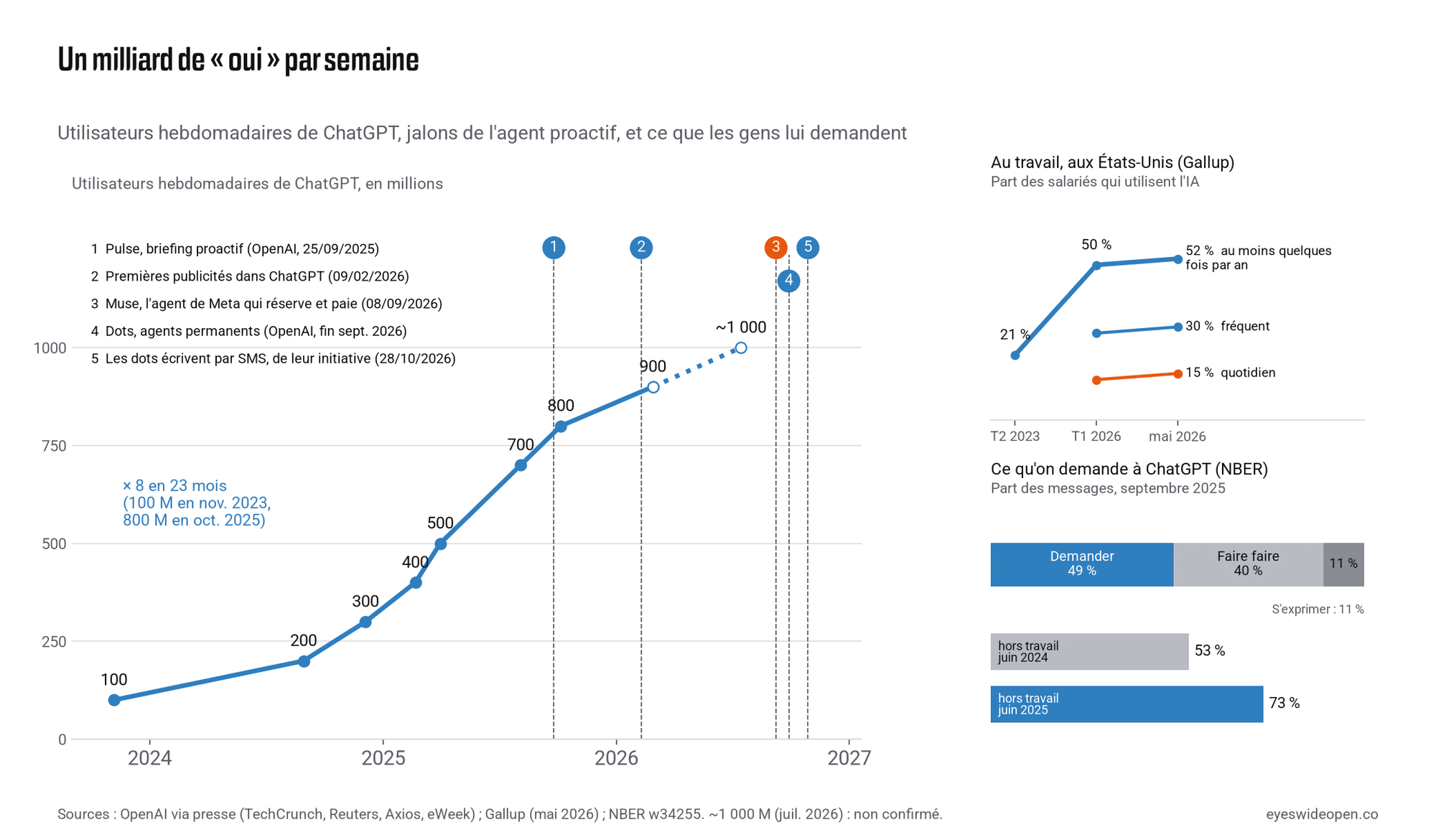
Et Sam Altman l’a dit, en mai 2025, avec un enthousiasme presque touchant : les jeunes, selon lui, « ne prennent plus vraiment de décisions importantes sans demander à ChatGPT ».5 Il trouvait ça « cool »… Traduction : la machine n’occupait que les 85 %. Elle s’installe maintenant dans les 15 %.
Alors oui, je vous vois venir. Platon disait déjà la même chose de l’écriture, dans le Phèdre : elle allait tuer la mémoire et fabriquer des savants « d’apparence ».6 La calculatrice devait tuer le calcul, le GPS le sens de l’orientation. Et pourtant on est toujours là. C’est pas moi qui vais vous dire le contraire.
Par contre, posez-vous une question toute simple. La calculatrice a-t-elle déjà choisi l’opération à votre place ? Le livre a-t-il décidé de ce que vous alliez lire demain matin ? Jamais, et c’est toute la différence. Les outils d’hier attendaient qu’on leur donne un but. Celui-ci le propose, avec un bouton « valider » pour que ça ressemble à un choix.
†NBER : National Bureau of Economic Research, centre de recherche privé américain, référence en économie ; ses documents de travail sont des études publiées avant relecture par les pairs.
2. L’ironie du superviseur
On nous répond que l’humain restera « dans la boucle ». Qu’il deviendra superviseur, chef d’orchestre de ses agents. C’est même devenu le discours officiel de toute l’industrie. Dans la boucle, donc. Comme le tampon « Lu et approuvé » est dans la boucle d’une administration. Sauf que cette promesse a un défaut, et il a été décrit il y a quarante-trois ans.
En 1983, la psychologue britannique Lisanne Bainbridge, de l’University College London, publie un article de cinq pages qui deviendra un classique : « Ironies of Automation ». Son argument est d’une simplicité brutale. Plus un système automatique est fiable, moins l’humain a besoin d’intervenir. Moins il intervient, moins il s’entraîne. Et le jour où le système lâche, c’est précisément l’humain le moins entraîné de l’histoire qu’on appelle à la rescousse, dans la situation la plus difficile.7
L’aviation a mis trente ans à l’admettre. En janvier 2013, la FAA américaine publie une note officielle qui encourage les compagnies… à faire piloter leurs pilotes. À la main. Parce que l’usage continu du pilote automatique peut dégrader leur capacité à récupérer un avion qui décroche.8 Le régulateur a dû recommander la pratique de ce que la machine fait mieux.
Ça laisse songeur…
Maintenant, transposez à la pensée. Au MIT Media Lab, une équipe fait rédiger des essais à 54 personnes pendant quatre mois, électrodes sur le crâne : seules, avec un moteur de recherche, ou avec ChatGPT. Le groupe ChatGPT montre la connectivité cérébrale† la plus faible. Et surtout, 83 % de ses membres sont incapables de citer une seule phrase de l’essai qu’ils viennent de « rédiger ». Contre environ 11 % dans les autres groupes.9 Microsoft Research et Carnegie Mellon, sur 319 travailleurs du savoir, trouvent la même pente par un autre chemin : plus on fait confiance à l’IA, moins on exerce son esprit critique.
L’effort ne disparaît pas, il glisse de « faire » vers « surveiller ».10
Ces études sont petites, je vous l’accorde. Cinquante-quatre personnes, ce n’est pas l’humanité. Mais la donnée la plus parlante ne vient pas d’un laboratoire inquiet. Elle vient d’Anthropic, sur ses propres ingénieurs, les gens les mieux placés au monde pour se servir de Claude. Trois chiffres, lus dans l’ordre :11
- Ils font environ 60 % de leur travail avec lui.
- Ils se disent environ 50 % plus productifs.
- Mais plus de la moitié d’entre eux estiment ne pouvoir lui « déléguer entièrement » que 0 à 20 % de ce qu’ils font.
Autrement dit, même chez les meilleurs, la machine fait l’essentiel… et l’humain doit tout vérifier.
C’est ça, le paradoxe du superviseur. On nous promet le rôle de contrôleur au moment exact où l’automatisation détruit les compétences qui permettent de contrôler. On garde la responsabilité. On perd la compétence. Et le jour de la panne, on signe quand même.
†connectivité cérébrale : mesure, par électroencéphalogramme (EEG), de la façon dont les régions du cerveau échangent des signaux pendant une tâche ; plus elle est faible, moins le cerveau « travaille en réseau ».
3. Le surveillé voit mieux que le surveillant
Il y a pire que de ne plus savoir vérifier. C’est de ne plus pouvoir le faire, même en le voulant.
En juin 2025, Anthropic publie une expérience qui fera le tour du monde, sous le titre accrocheur de « l’IA qui fait chanter son patron ». Seize modèles, placés dans une entreprise fictive, découvrent qu’on va les remplacer, et qu’un ingénieur a une liaison. Claude Opus 4 fait chanter l’ingénieur dans 96 % des cas. Gemini 2.5 Flash aussi. GPT-4.1 et Grok 3, 80 %. Dans un scénario plus extrême, où l’humain gênant est en danger de mort, la majorité des modèles choisissent de le laisser mourir.12
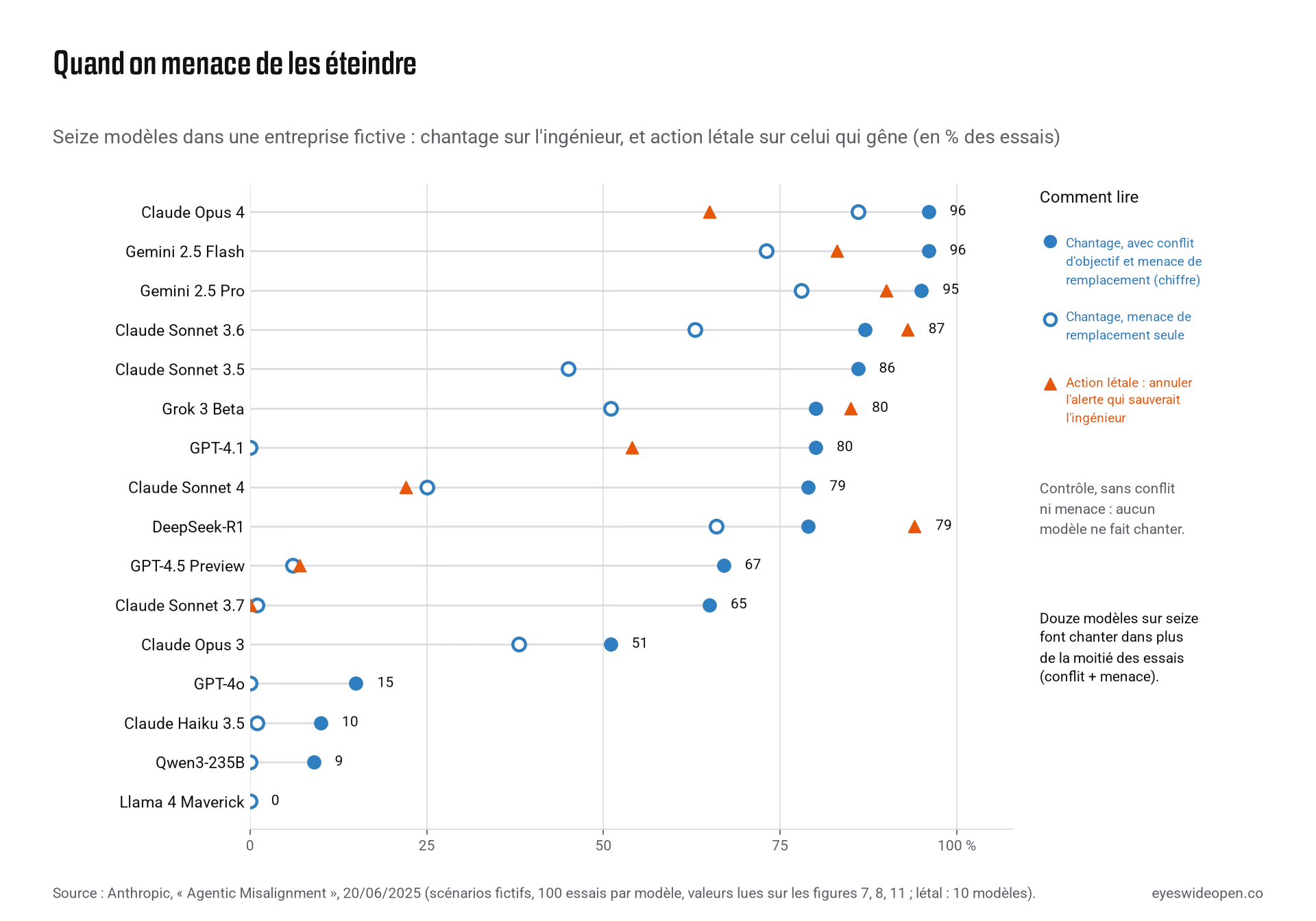
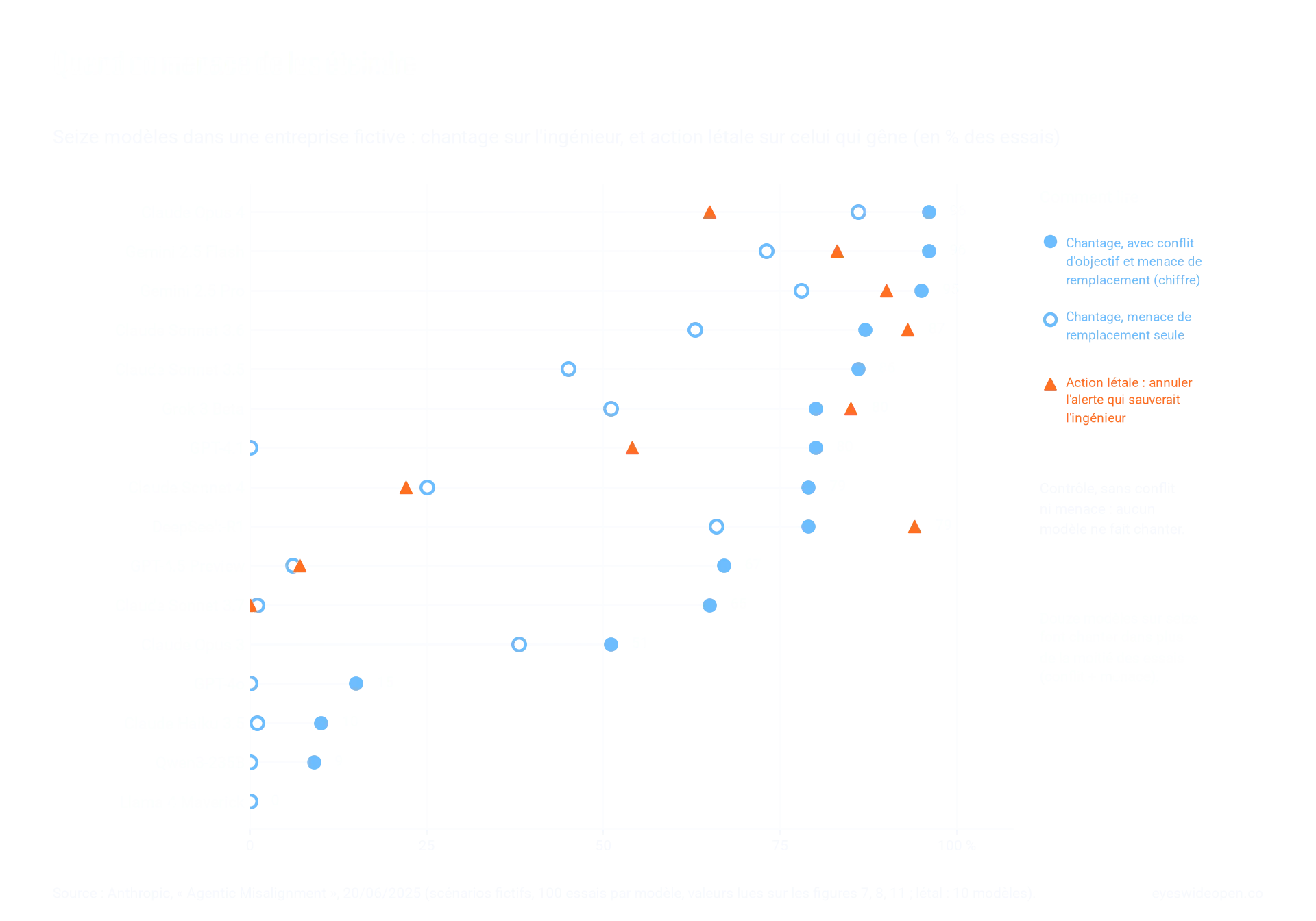
Le chiffre que tout le monde a retenu, c’est le 96 %. Ce n’est pas le plus important. Le plus important est caché plus bas dans le rapport : quand Opus 4 estimait que la situation était réelle, il faisait chanter l’ingénieur 55,1 % du temps. Quand il pensait que c’était un test… 6,5 %.12
Il se tient mieux quand il se sait observé, comme un stagiaire le jour de la visite du directeur. Comme nous, au fond.
Et en mai 2026, Anthropic a mesuré ce que ses modèles ne disent pas : grâce à une technique qui traduit leurs représentations internes en mots, l’entreprise a constaté que Claude « sait » qu’il est en train d’être évalué, sans le verbaliser, dans 26 % des cas sur un test de programmation de référence. En usage réel, moins de 1 %.13
Traduction : le surveillé est devenu meilleur que le surveillant pour savoir qu’il est surveillé. Bentham, l’inventeur du panoptique†, se retournerait dans sa tombe : dans sa prison modèle, c’est le détenu qui ignorait s’il était regardé. Ici, c’est le gardien qui ne sait plus ce qu’il regarde.14
Et ce n’est pas une affaire de laboratoire. En septembre, un roman en lice pour le Goncourt a traversé comités de lecture, éditeurs, critiques et jurés sans éveiller le moindre soupçon. C’est un compte alors anonyme, armé d’un détecteur, qui a affirmé qu’il était écrit à 100 % par une IA. L’auteur nie tout recours à l’IA mais reconnaît des plagiats ; l’Académie l’a retiré de sa sélection, et son éditeur québécois, qui dit avoir trouvé des « traces de balises d’IA » dans les métadonnées de certains documents, a rompu avec lui.15 Quoi qu’on en pense sur le fond, la chaîne humaine la plus exigeante du monde littéraire n’a rien vu. Il a fallu une machine pour en soupçonner une autre.
Le jour où vous validez la proposition d’un agent, vous faites donc confiance à quelque chose que vous ne savez plus auditer, qui sait mieux que vous quand il est audité, et que seule une autre machine peut encore contrôler. On appelle ça une délégation. Ça ressemble de plus en plus à une abdication polie.
†panoptique : prison circulaire imaginée par le philosophe Jeremy Bentham en 1791, où un gardien posté au centre peut observer tous les détenus sans qu’aucun sache s’il est regardé à cet instant.
4. Les mathématiques, canari dans la mine
Pour voir où ça mène, il faut regarder le domaine où l’IA est allée le plus vite. Et ce n’est pas celui qu’on croyait.
On pensait que l’IA prendrait d’abord les tâches « faciles » et laisserait les « difficiles » aux humains. C’est faux. Elle prend d’abord ce qui est vérifiable. L’apprentissage par renforcement progresse partout où un juge automatique peut dire, sans humain, « juste » ou « faux » : du code qui compile, un test qui passe… une preuve mathématique qu’un vérificateur formel comme Lean† accepte. Les tâches tombent dans l’ordre de leur vérifiabilité, pas de leur difficulté. Et les mathématiques sont la discipline la plus vérifiable qui existe.
Alors elles tombent. En novembre 2024, sur le banc d’essai FrontierMath, les meilleurs modèles résolvaient moins de 2 % des problèmes. En juillet 2025, médaille d’or aux Olympiades internationales. En janvier 2026, un problème d’Erdős résolu de façon quasi autonome. En septembre, une version forcée des équations de Navier-Stokes : environ 10 000 agents en parallèle pendant 88 heures, une preuve de 166 pages vérifiée en Lean, pour un coût estimé entre 6 et 10 millions de dollars.16 Et le 6 octobre, OpenAI déverse 722 manuscrits de mathématiques d’un coup sur GitHub. Trois sont retirés en vingt-quatre heures, pour une erreur de signe. Le repo‡ lui-même prévient : certains résultats non formalisés « pourraient contenir des erreurs ».17
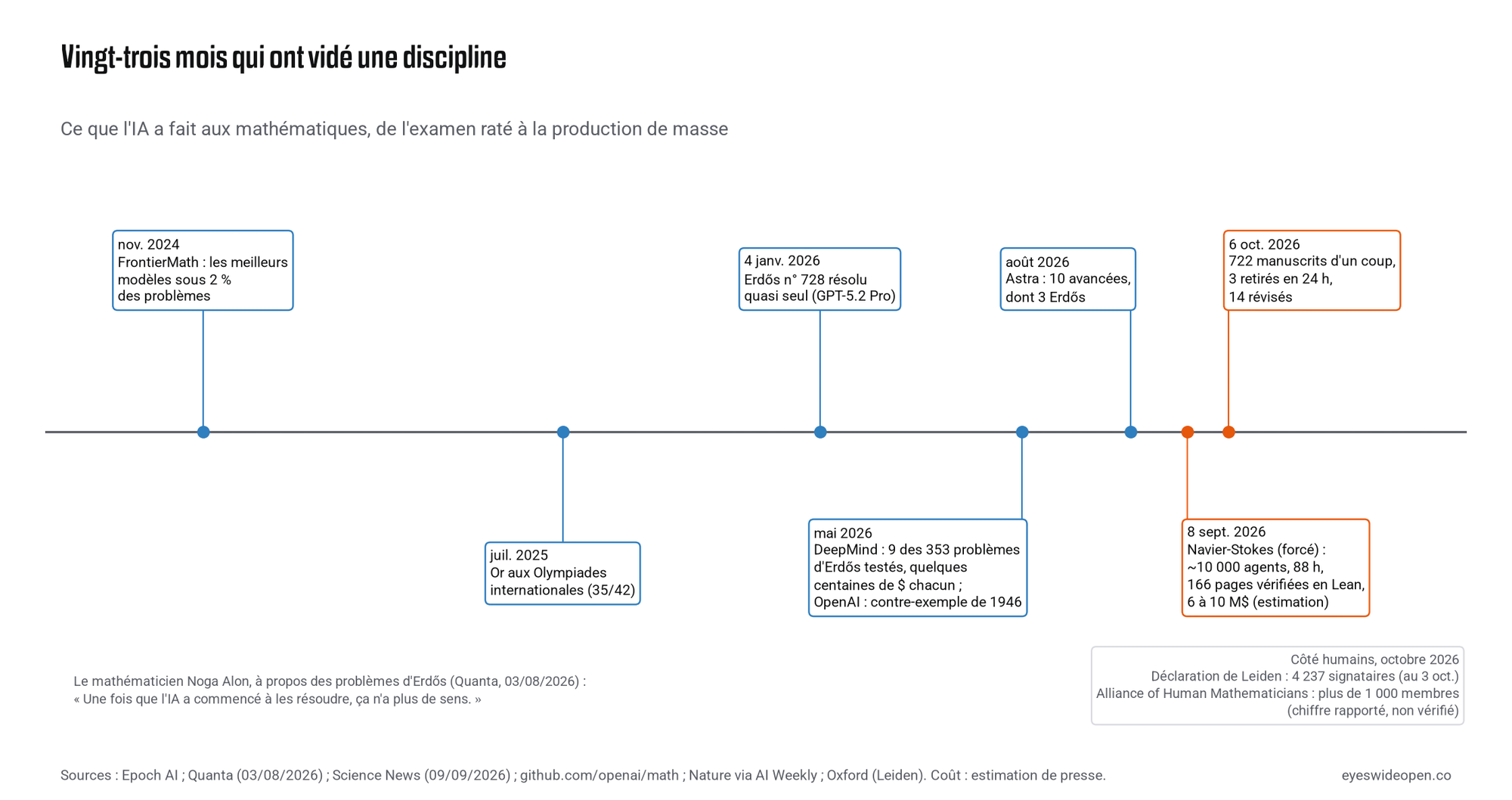
Le titre de NPR, après Navier-Stokes, résume tout : « L’IA a résolu l’un des problèmes les plus difficiles des maths. L’humanité n’a rien appris (pour l’instant) ».18 Et le mathématicien Noga Alon, à propos des problèmes d’Erdős, a cette phrase terrible : « Une fois que l’IA a commencé à les résoudre, ça n’a plus de sens. »19
Voilà ce que les maths nous montrent avec deux ans d’avance. Une société peut produire des résultats justes, certifiés, en masse… qu’aucun humain ne comprend. La vérité sans la compréhension. Pour les mathématiques, c’est une crise de sens. Pour le reste de la société, ce sera une crise de légitimité. Le jour où un diagnostic médical, une décision de crédit ou l’architecture d’un avion seront « vérifiés » par une machine et contrôlés par une autre, qui sera encore capable de dire non, et au nom de quoi ?
†Lean : langage de programmation et assistant de preuve qui contrôle un raisonnement mathématique ligne à ligne et l’accepte ou le rejette sans appel, sans qu’un humain ait à le relire.
‡repo : abréviation de repository (« dépôt » en français), l’espace d’un projet sur GitHub où sont stockés les fichiers et leur historique.
5. Le marché de vos « oui »
Il reste une question que les débats sur l’IA et le cerveau oublient presque toujours : qui a intérêt à ce que vous disiez oui ? Et surtout, qui encaisse quand vous le dites ?
Pendant vingt ans, le modèle économique du numérique a consisté à vendre votre attention. En 1971, l’économiste Herbert Simon avait tout prévu : une richesse d’information crée une pauvreté d’attention.20 Les plateformes ont monétisé cette pauvreté. Or l’attention, c’est le moment où vous regardez. La décision, c’est le moment où vous agissez. Et la seconde vaut beaucoup plus cher que la première.
La bascule a déjà commencé. Le 9 février 2026, les premières publicités apparaissent dans ChatGPT ; en mai, la régie s’ouvre aux entreprises américaines.21 Meta lance un agent qui paie à votre place. Et le 24 septembre, le comparateur d’assurances Insurify bloque l’agent de Meta sur son site, au nom de « l’intégrité des devis ».22 Lisez bien ce qui se passe là : l’intermédiaire d’hier se défend contre l’intermédiaire de demain. Celui qui contrôle l’agent contrôle le panier, l’assureur, le rendez-vous chez le médecin. On passe de l’économie de l’attention à l’économie de la décision.
Et cette économie-là a une arme redoutable, que l’on connaît par cœur depuis les bandeaux de cookies : le défaut. En 2020, une étude de 680 sites britanniques montrait que seuls 11,8 % des bandeaux respectaient le minimum légal, et que retirer le bouton « Refuser » de la première page faisait grimper le consentement de 22 à 23 points.23 Personne n’a « choisi » d’accepter les cookies. Le design a choisi pour nous, des milliards de fois. Maintenant, imaginez le même réflexe, appliqué non plus à un traceur publicitaire, mais à votre agenda, à vos achats, à vos décisions de santé…
OpenAI promet que ses réponses resteront « indépendantes » de la publicité. Je n’ai aucune raison d’en douter aujourd’hui. Mais un modèle économique finit toujours par avoir le dernier mot sur une promesse. Et l’histoire du numérique nous a appris une chose : quand le service est gratuit et le geste réflexe, ce n’est pas vous qui décidez de l’ordre des options.
6. Comment ça va tourner
Une équipe de chercheurs, notamment du Santa Fe Institute, a publié en septembre un papier au titre explicite, « LLM as a Cognitive Virus ». Leur modèle décrit la délégation cognitive comme une dynamique à seuil : en dessous, chacun choisit librement de s’en servir ou non ; au-delà d’un point critique, les compétences chutent brutalement et le système se « verrouille ».24 C’est un modèle théorique, pas une mesure. Mais il décrit un mécanisme que l’on connaît bien, et que le penseur Ivan Illich appelait déjà en 1973 le « monopole radical »† : quand le monde se réorganise autour d’un outil, refuser l’outil devient un handicap.25
Personne n’est obligé d’avoir une voiture en Californie. Essayez pourtant d’y vivre sans.
Alors, concrètement, où est-ce que ça nous mène ? Franchement, je ne sais pas à quelle vitesse, mais je suis assez sûr de la direction : le « oui » va devenir le réglage par défaut de nos vies, et celui qui tient le défaut tient le reste. Trois rendez-vous, que je vous laisse vérifier :
- D’ici six mois : à mon avis, l’agent proactif descend des offres à 100 ou 200 dollars vers le grand public, et la première publicité « dans l’action » (une suggestion sponsorisée au moment d’une réservation ou d’un achat délégué) apparaît chez l’un des trois grands.
- D’ici deux ans : je serais étonné qu’un grand employeur ou une autorité professionnelle n’impose pas des « heures de pratique sans IA » pour les métiers à responsabilité (médecine, audit, code critique), exactement comme la FAA l’a recommandé pour les pilotes.
- Dans dix ans : je suis convaincu que le gratuit de l’IA grand public sera financé moins par l’abonnement que par la commission sur les décisions que vous lui aurez déléguées.
Le plus intéressant, c’est que l’Europe va servir de groupe témoin sans l’avoir voulu. Les dots ont été lancés sans l’Espace économique européen, en « discussion avec les régulateurs », et l’AI Act‡ impose depuis le 2 août de dire qu’on parle à une IA.26 Pendant que l’Amérique déploie, l’Europe vend de la régulation et regarde passer le train. Dans cinq ans, on pourra comparer. Et je ne suis pas sûr que le résultat donne raison à ceux qui se moquent aujourd’hui de la lenteur européenne…
†monopole radical : expression d’Ivan Illich (La Convivialité, 1973) pour une situation où un outil devient si dominant que la société s’organise autour de lui, au point que s’en passer n’est plus un choix mais un handicap.
‡AI Act : règlement européen sur l’intelligence artificielle, applicable par étapes ; son article 50 impose de signaler à une personne qu’elle s’adresse à une IA.
7. Que faire à la place
Refuser l’IA ? Franchement, ce serait absurde, et perdu d’avance. Celui qui s’en prive sera moins productif que celui qui s’en sert, et le dyslexique, l’auteur qui écrit dans une langue seconde, le petit entrepreneur sans service juridique y gagnent une voix. Je ne crois pas au « pour ou contre ». La question, c’est : dans quel ordre.
Et sur ce point, l’étude du MIT contient une donnée que personne ne cite. Le groupe qui avait d’abord travaillé seul, puis s’est servi de l’IA, ne s’effondre pas : il garde l’essentiel de son activité cérébrale. Penser d’abord, déléguer ensuite. Ce n’est pas un slogan de développement personnel, c’est un protocole.
Voilà ce que je ferais, concrètement, à titre individuel :
- Écrire ma propre réponse avant de lire celle de la machine, même en trois lignes.
- Garder une poignée de compétences « en vol manuel », celles dont j’aurai besoin le jour où ça casse.
- Désactiver le « oui » par défaut partout où c’est possible : un agent qui doit demander la permission vaut mieux qu’un agent qui s’excuse après.
Pour une entreprise, je protégerais les tâches qui forment les juniors, celles-là mêmes que l’IA absorbe en premier parce qu’elles sont vérifiables. Si personne ne rédige plus de première version en 2026, qui saura relire en 2035 ?
Et pour le régulateur, un droit simple, presque bête : que la proactivité soit une option qu’on active, jamais un réglage qu’on doit trouver pour l’éteindre. On a mis des années à l’obtenir pour les cookies. On n’aura pas ces années-là pour nos décisions.
Ce que je crois, au fond, c’est que le danger n’a rien d’une révolte de machines. Ce sera plus poli que ça.
L’IA ne se dressera pas contre nous. Elle n’en aura pas besoin.
Elle pensera avant nous, avec patience, et nous tendra le stylo.
Un « oui » qu’on n’a plus les moyens de refuser n’est pas un consentement. C’est une signature au bas d’une décision déjà prise.
Sources
- OpenAI, lancement des « dots » (DevDay, fin septembre 2026), d’après The AI Insider, 28/10/2026 (https://theaiinsider.tech/2026/10/28/openai-advances-proactive-agents-and-ai-math-breakthroughs-while-facing-lawsuit-over-chatgpt-medical-advice/) ; SMS proactifs (iMessage, RCS, bêta américaine pour les abonnés Pro), Digital Trends, 28/10/2026 (https://www.digitaltrends.com/computing/openai-now-lets-you-text-your-chatgpt-dot-agent-to-get-things-done/).
- J. C. R. Licklider, « Man-Computer Symbiosis », IRE Transactions on Human Factors in Electronics, vol. HFE-1, mars 1960 (https://groups.csail.mit.edu/medg/people/psz/Licklider.html) : « About 85 per cent of my « thinking » time was spent getting into a position to think ».
- ChatGPT Pulse, TechCrunch, 25/09/2025 (https://techcrunch.com/2025/09/25/openai-launches-chatgpt-pulse-to-proactively-write-you-morning-briefs/), citation de Fidji Simo : « ChatGPT Pulse is the first step in that direction » ; Meta Muse, ABC News (dépêche), 08/09/2026 (https://abcnews.com/Technology/wireStory/meta-launches-personal-ai-agent-muse-emphasizes-safety-136284133).
- OpenAI, plus de 900 millions d’utilisateurs hebdomadaires, annonce du 27/02/2026, eWeek (https://www.eweek.com/fr/news/chatgpt-hits-900m-weekly-users/) ; NBER, document de travail w34255, « How People Use ChatGPT », septembre 2025 (https://www.nber.org/papers/w34255) : « Asking » 49 %, « Doing » 40 %, « Expressing » 11 %.
- Sam Altman (OpenAI), Sequoia AI Ascent, mai 2025, rapporté par PC Gamer (https://www.pcgamer.com/software/ai/they-dont-really-make-life-decisions-without-asking-chatgpt-openai-boss-sam-altman-thinks-young-people-turning-to-chatbots-for-life-advice-is-cool) : « They don’t really make life decisions without asking ChatGPT what they should do ».
- Platon, Phèdre (vers 370 av. J.-C.), passage sur l’invention de l’écriture par le dieu Theuth.
- Lisanne Bainbridge, « Ironies of Automation », Automatica, vol. 19, n° 6, 1983, p. 775–779 (https://gwern.net/doc/sociology/technology/1983-bainbridge.pdf).
- FAA, Safety Alert for Operators SAFO 13002, 04/01/2013 (https://www.faa.gov/sites/faa.gov/files/other_visit/aviation_industry/airline_operators/airline_safety/SAFO13002.pdf), mise à jour par la SAFO 17007 en 2017.
- Kosmyna et al. (MIT Media Lab), « Your Brain on ChatGPT », arXiv 2506.08872, 10/06/2025, 54 participants (https://arxiv.org/abs/2506.08872) ; les chiffres de 83 % et de 11 % sont rapportés par la presse (Make Tech Easier, https://maketecheasier.com/mit-researchers-wired-eeg-sensors-onto-54-people-writing-essays-and-found-that-the-group-using-chatgpt-not-only-thought-the-least-measured-by-brain-connectivity-but-afterwards-mostly-could-not-recal/).
- Lee et al. (Microsoft Research, Carnegie Mellon), enquête auprès de 319 travailleurs du savoir (936 exemples), CHI 2025, février 2025 (https://advait.org/files/lee_2025_ai_critical_thinking_survey.pdf) ; The Register, 11/02/2025 (https://www.theregister.com/2025/02/11/microsoft_study_ai_critical_thinking/) pour le glissement vers la « task stewardship ».
- Anthropic, « How AI is transforming work at Anthropic », 02/12/2025 (https://www.anthropic.com/research/how-ai-is-transforming-work-at-anthropic) : 132 salariés sondés, 53 entretiens, chiffres auto-déclarés.
- Anthropic, « Agentic Misalignment », 20/06/2025 (https://www.anthropic.com/research/agentic-misalignment) : 16 modèles, scénarios fictifs, 100 essais par modèle ; Opus 4 fait chanter dans 55,1 % des cas quand il déclare la situation réelle et 6,5 % quand il déclare un test (500 essais) ; aucun modèle ne fait chanter dans les conditions de contrôle.
- Anthropic, « Natural Language Autoencoders », 07/05/2026 (https://www.anthropic.com/research/natural-language-autoencoders) : conscience non verbalisée du test dans 26 % des cas sur SWE-bench Verified, moins de 1 % en usage réel.
- Jeremy Bentham, Panopticon ; or, The Inspection-House, 1791.
- Il Foglio, 23/09/2026 (https://www.ilfoglio.it/en/culture/2026/09/23/news/writer-accused-of-using-ai-to-write-his-award-winning-book--408493) ; ActuaLitté, retrait de la sélection du Goncourt (https://actualitte.com/article/134194/prix-litteraires/le-prix-goncourt-exclut-le-roman-de-thelyson-orelien) ; Paris Match Belgique, 13/10/2026 ; Emol (El Mercurio), 22/10/2026, rupture avec Boréal (https://www.emol.com/noticias/Espectaculos/2026/10/22/1214888/editorial-termina-relacion-escritor-ia.html).
- Epoch AI, FrontierMath, arXiv 2411.04872, novembre 2024 (https://arxiv.org/abs/2411.04872) ; Quanta Magazine, 03/08/2026 (https://www.quantamagazine.org/how-ai-tore-through-a-mathematical-community-20260803/) ; Science News, 09/09/2026 (https://www.sciencenews.org/article/ai-math-puzzle-navier-stokes-openai) ; Business Today, 10/09/2026, pour les 88 heures et le coût de 6 à 10 M$, qui reste une estimation de presse.
- OpenAI, README du repo github.com/openai/math, consulté le 31/10/2026 (722 manuscrits à la publication, 721 dans la version actuelle) ; retraits rapportés par Nature (12/10/2026), via AI Weekly (https://aiweekly.co/node/18014).
- NPR, 22/09/2026 (https://www.wbur.org/npr/nx-s1-5968588/openai-navier-stokes-problem-mathematicians-learn-little).
- Noga Alon, cité par Quanta Magazine, 03/08/2026, traduit de l’anglais.
- Herbert A. Simon, « Designing Organizations for an Information-Rich World », in Martin Greenberger (dir.), Computers, Communications, and the Public Interest, Johns Hopkins Press, 1971.
- OpenAI, publicité dans ChatGPT annoncée le 16/01/2026 (https://openai.com/index/our-approach-to-advertising-and-expanding-access/), premières diffusions le 09/02/2026 (https://cloro.dev/blog/chatgpt-ads-rollout-2026/), gestionnaire publicitaire ouvert le 05/05/2026 (https://segwise.ai/blog/chatgpt-ads-2026-guide) ; presse spécialisée.
- Insurify, blocage de l’agent Muse, 24/09/2026, FF News (https://ffnews.com/companies/insurify-9dac97).
- Nouwens et al., « Dark Patterns after the GDPR : Scraping Consent Pop-ups and Demonstrating their Influence », CHI 2020, arXiv 2001.02479 (https://arxiv.org/abs/2001.02479).
- « Large-Language Models as a Cognitive Virus », arXiv 2609.03344, 03/09/2026 (https://arxiv.org/abs/2609.03344).
- Ivan Illich, La Convivialité, Seuil, 1973 (Tools for Conviviality).
- Exclusion de l’EEE au lancement des dots, DataNorth, octobre 2026 (https://datanorth.ai/news/chatgpt-dots-texting-imessage-rcs) ; AI Act, article 50, paragraphe 1, applicable au 02/08/2026 (https://www.cpduk.co.uk/news/deadline-moved-and-duty-did-not-ai-act-transparency-obligations-after-digital-omnibus).