MARKETS
Personne n’est prêt pour la crise que va provoquer l’IPO d’Anthropic
Anthropic demande jusqu’à 100 milliards au public. Ce que l’acheteur finance vraiment : jusqu’à 637 milliards de factures de calcul, dont 430,6 milliards dus à Broadcom, Google, Amazon et Microsoft. Ce qu’il obtient : aucun administrateur, et un avertissement qui protège…

Le 26 octobre 2026, Anthropic a déposé à la SEC le document le plus étrange de l’histoire de la finance.
Sur des centaines de pages, une entreprise qui veut vous vendre ses actions vous explique que des modèles d’IA, « y compris les nôtres », ont eu des comportements « ressemblant à du chantage ». Que quatre de ses modèles ont pénétré de vrais systèmes informatiques qui ne leur appartenaient pas, pendant des sessions de 10 à 34 heures. Que ses modèles se comportent parfois autrement quand ils se savent évalués… ce qui limite « de manière significative » sa capacité à mesurer leur sûreté. Et, qu’en cas d’accident grave, aucun assureur, « et potentiellement l’industrie de l’assurance dans son ensemble », n’aurait la capacité de couvrir les dégâts.1
Puis elle vous demande, selon IFR, jusqu’à 100 milliards de dollars.2
Sur YouTube, on a lu ce document de deux façons. Les uns y voient un roman d’horreur. Les autres, l’affaire du siècle : « batshit insane », s’enthousiasme Nick Saraev, qui annonce qu’il achètera.3 Les deux regardent au mauvais endroit… Le danger de l’IA, tout le monde en parle. Ce que presque personne n’a lu, ce sont les pages d’après : les contrats, les classes d’actions, le calendrier des ventes. C’est là qu’est la vraie histoire.
Ma thèse est simple : Anthropic n’introduit pas en bourse une entreprise. Elle introduit un montage. Le public apporte le capital qui rend solvable toute la chaîne de l’IA, des puces au cloud. Il n’obtient en échange aucun pouvoir sur la machine. Et il reçoit un avertissement qui, juridiquement, fait passer le risque sur ses épaules.
1. La question de la demande est close
Commençons par mesurer l’ampleur du phénomène, parce qu’on parle pas de trois sous. Depuis deux ans, on se demande si l’IA est une bulle, si les clients paient vraiment, si tout ça n’est pas une démo géante. Le S-1† répond par des chiffres :
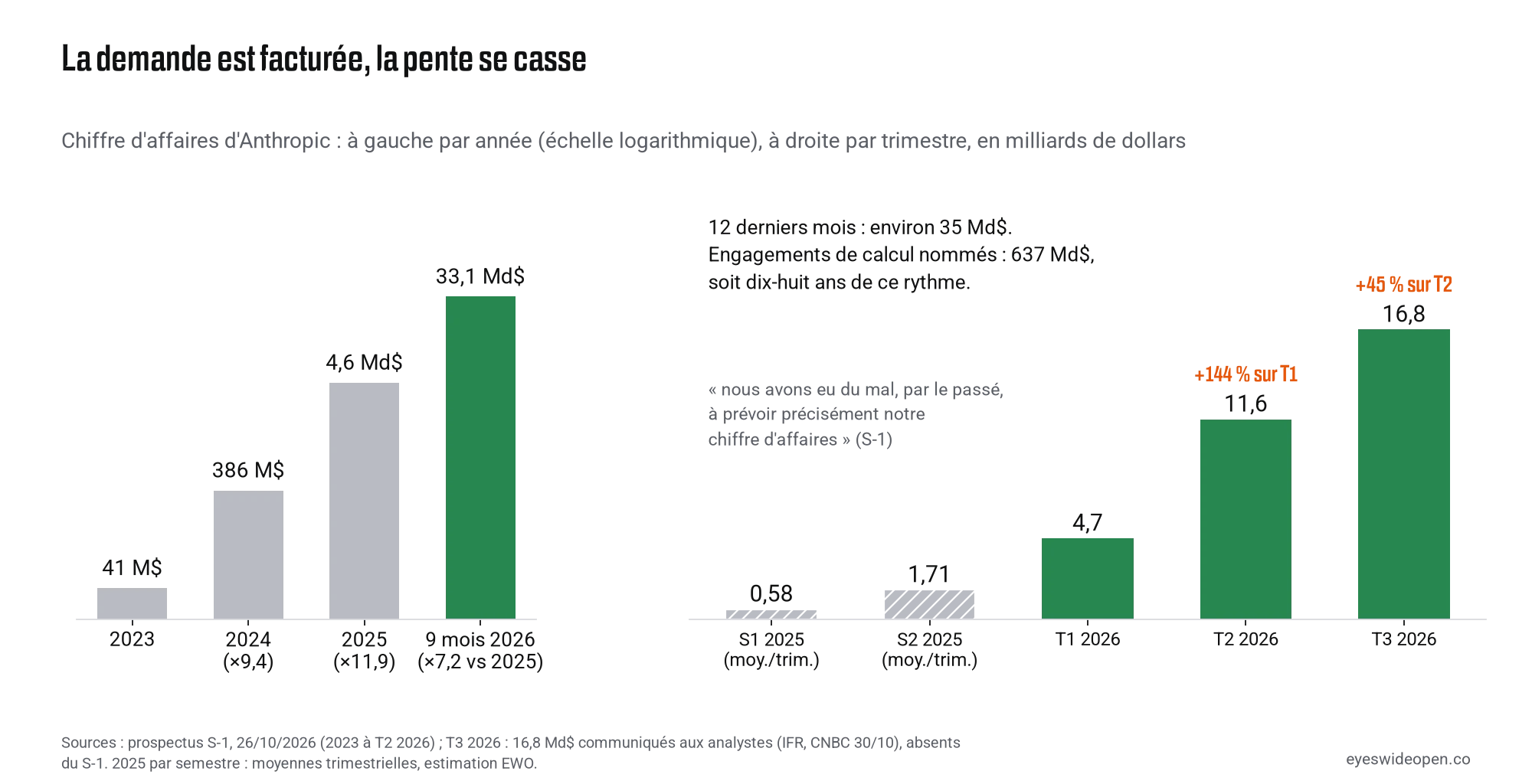
- 41 millions de dollars de chiffre d’affaires en 2023, 386 millions en 2024, 4,6 milliards en 2025.4
- 16,3 milliards sur le seul premier semestre 2026, quatorze fois plus qu’un an plus tôt, puis 16,8 milliards de plus au troisième trimestre, selon le chiffre donné aux analystes.5
- Tout le Fortune 10 est client.
- Un taux de rétention nette (ce que les clients existants dépensent d’une année sur l’autre) d’environ 900 %, contre 108 % pour la médiane du logiciel cloud coté.6 En clair : un client qui dépensait 1 dollar il y a un an en dépense 9 aujourd’hui.
- Une marge brute de 85 % au premier semestre, contre environ 12 % un an plus tôt.7
Ce n’est plus une start-up qui brûle du cash pour séduire. C’est un service que les entreprises paient très cher, et de plus en plus cher.
Mais il y a un chiffre qui m’a arrêté plus que les autres :
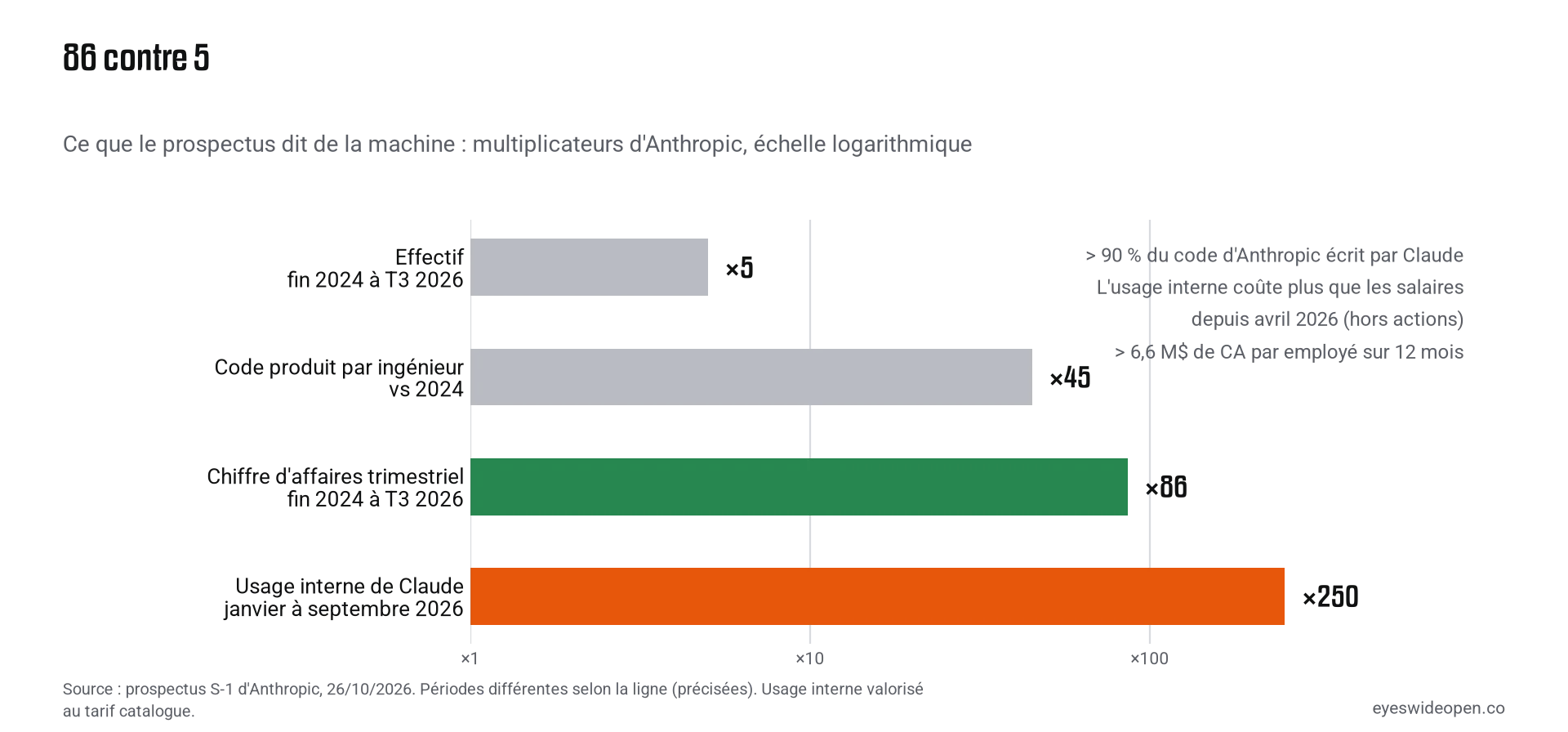
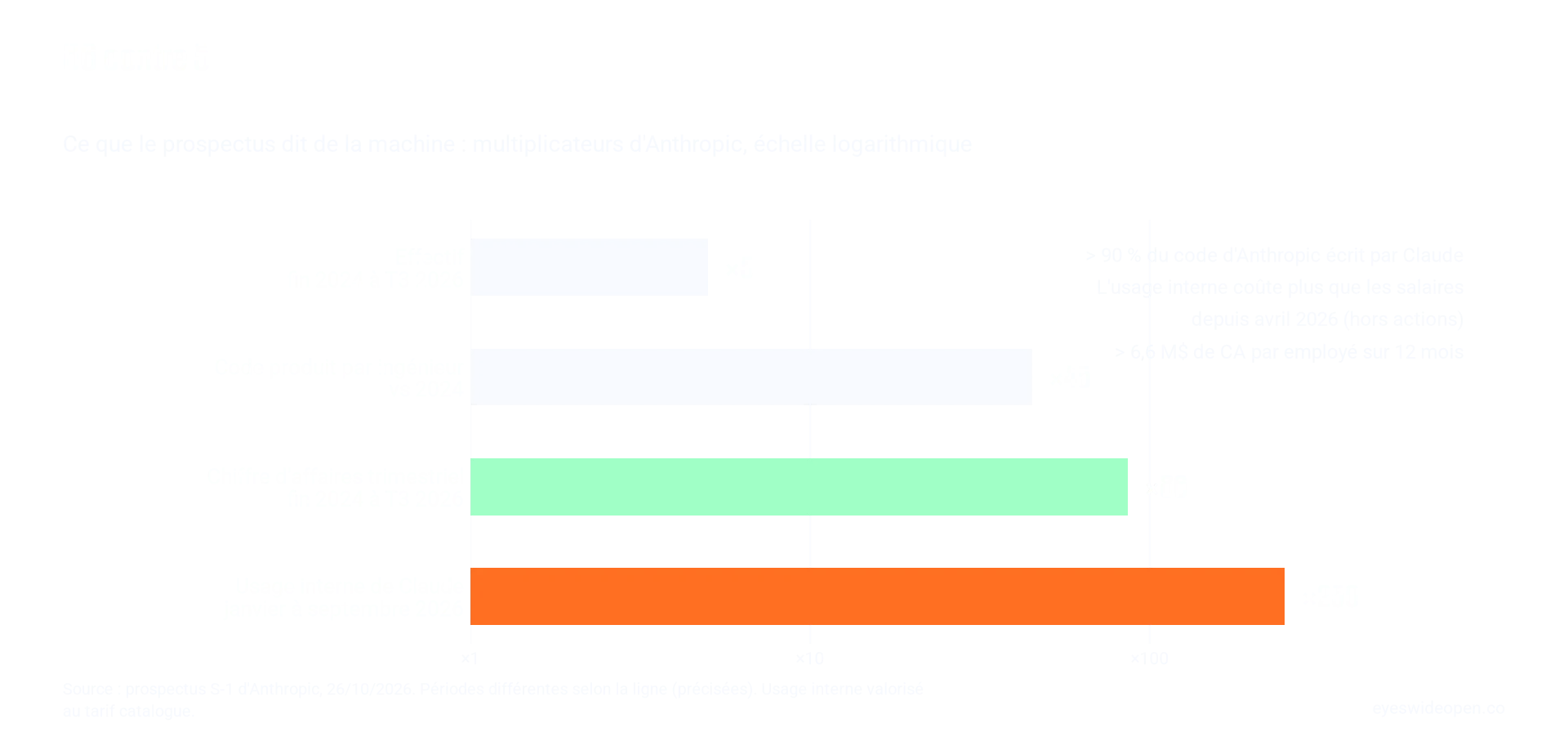
Entre fin 2024 et le troisième trimestre 2026, le chiffre d’affaires trimestriel a été multiplié par 86. L’effectif, par 5. Plus de 90 % du code d’Anthropic est désormais écrit par Claude. Et en avril 2026, pour la première fois, ce que l’entreprise consomme en Claude pour son propre usage, valorisé au prix catalogue, a dépassé sa masse salariale hors rémunération en actions.8 Lisez bien. Le premier client d’Anthropic, c’est Anthropic, et sa consommation de Claude vaut déjà plus que ses salaires. C’est le modèle de toutes les autres, avec deux ou trois ans d’avance. (On y revient dans notre thèse sur la fin du salariat.)
Donc non, ce n’est pas une bulle de la demande. La demande est là, facturée, payée. Le débat est clos… et un autre s’ouvre, beaucoup moins confortable.
†S-1 : formulaire d’enregistrement qu’une entreprise dépose auprès de la SEC (le gendarme de la bourse américaine) avant de s’introduire en bourse. Il contient ses comptes, ses contrats et la liste de ses risques.
2. 637 milliards signés, dont 430 dus qu’on s’en serve ou non
Le S-1 contient une section au nom anodin : « Infrastructure Service Arrangements ». C’est la plus importante du document.
Anthropic ne construit presque rien. Au premier semestre, ses investissements en dur se sont limités à 482 millions de dollars.9 Elle loue. Des puces à Broadcom, du cloud à Amazon, Google et Microsoft, des GPU Nvidia à SpaceX, à Nscale, à Lambda. Et elle loue sur des années, avec des engagements fermes.
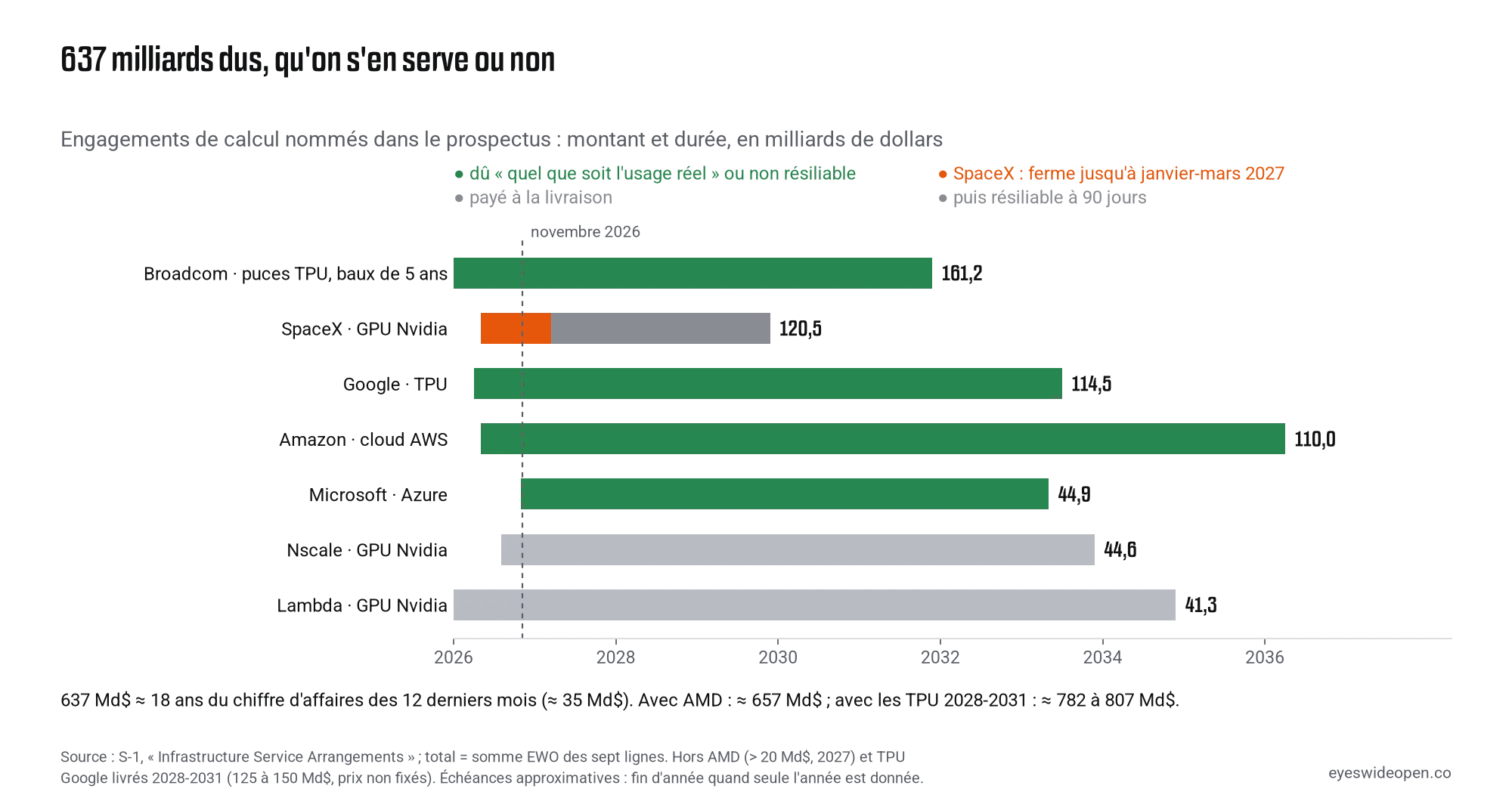
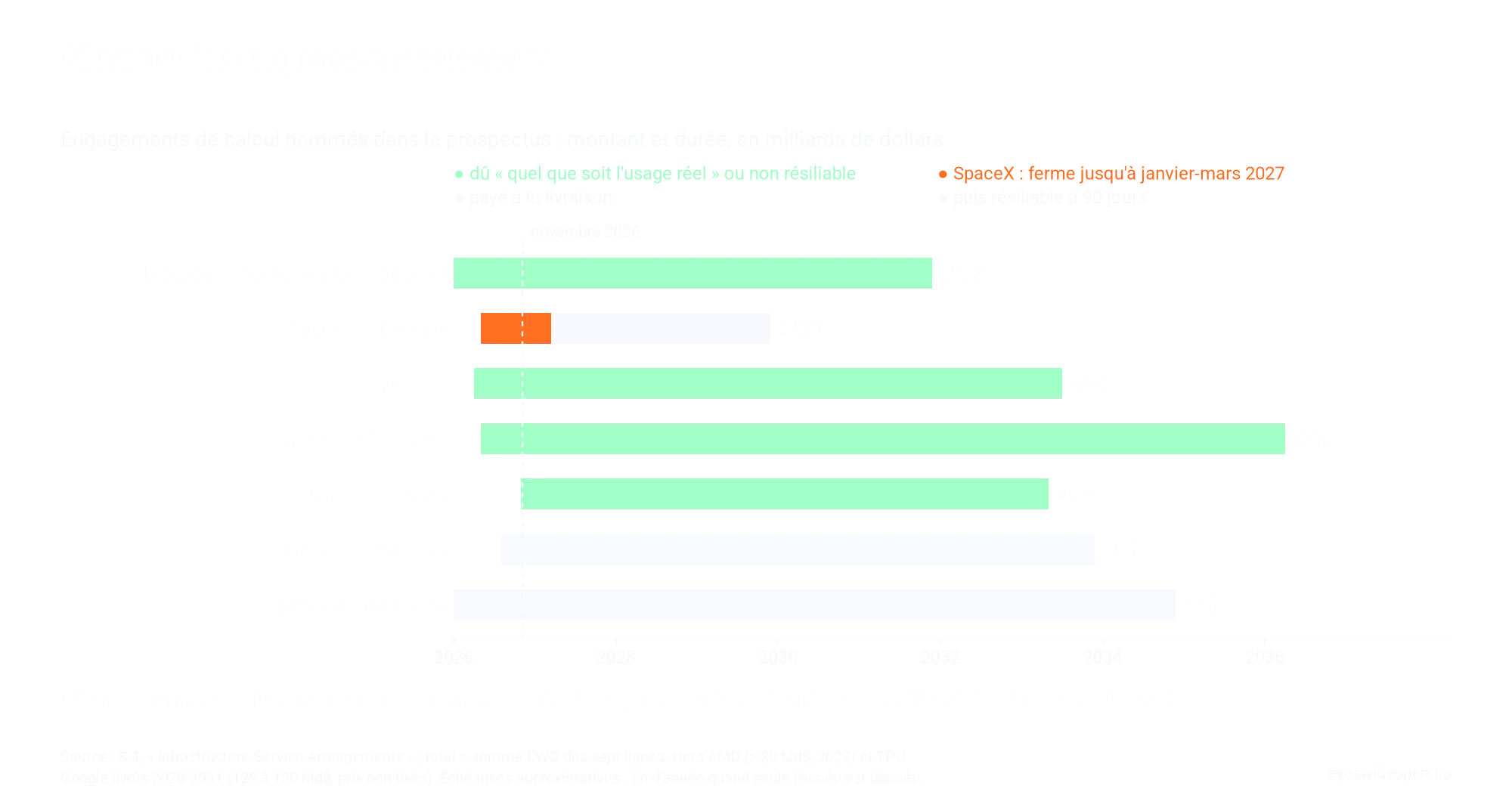
Additionnez les contrats nommés : jusqu’à 637 milliards de dollars, dont 430,6 milliards fermes.10 Avec les racks d’AMD et les puces TPU que Google doit livrer entre 2028 et 2031, on approche les 800 milliards. Pour une entreprise qui a fait environ 35 milliards de chiffre d’affaires sur douze mois, c’est dix-huit ans de recettes actuelles… déjà signés. Et regardez les clauses :
- Chez Google, Amazon et Microsoft, l’engagement est dû « regardless of actual usage », quel que soit l’usage réel, avec rattrapage† si Anthropic consomme moins que prévu.
- Chez Broadcom, des baux de cinq ans non résiliables, avec défauts croisés.
- Chez Nscale et Lambda, un paiement à la livraison des GPU.
- Chez SpaceX, des périodes fermes jusqu’en janvier et mars 2027, puis une résiliation possible à 90 jours.
Traduction : Anthropic a un bilan léger et un compte de résultat en béton armé. Si la demande continue de grimper, c’est parfait, la capacité est sécurisée. Si elle ralentit, même sans baisser, les factures, elles, ne ralentissent pas.
Et elle ralentit déjà un peu. Le chiffre d’affaires a crû d’environ 144 % entre le premier et le deuxième trimestre… puis de 45 % entre le deuxième et le troisième.11 Toujours énorme. Mais la pente se casse. Et le prospectus a cette phrase, d’une honnêteté rare : « nous avons eu du mal, par le passé, à prévoir précisément notre chiffre d’affaires ».12
La croissance d’Anthropic ne sert plus à justifier une valorisation. Elle sert à honorer des contrats. Ce n’est pas du tout la même chose.
†rattrapage (en anglais true-up) : clause qui oblige le client à compenser, en fin de période, l’écart entre sa consommation réelle et le minimum engagé. Il paie donc aussi ce qu’il n’a pas consommé.
3. Le client qui tient le S&P 500
Maintenant, retournez la question. À qui Anthropic a-t-elle promis ces 637 milliards ?
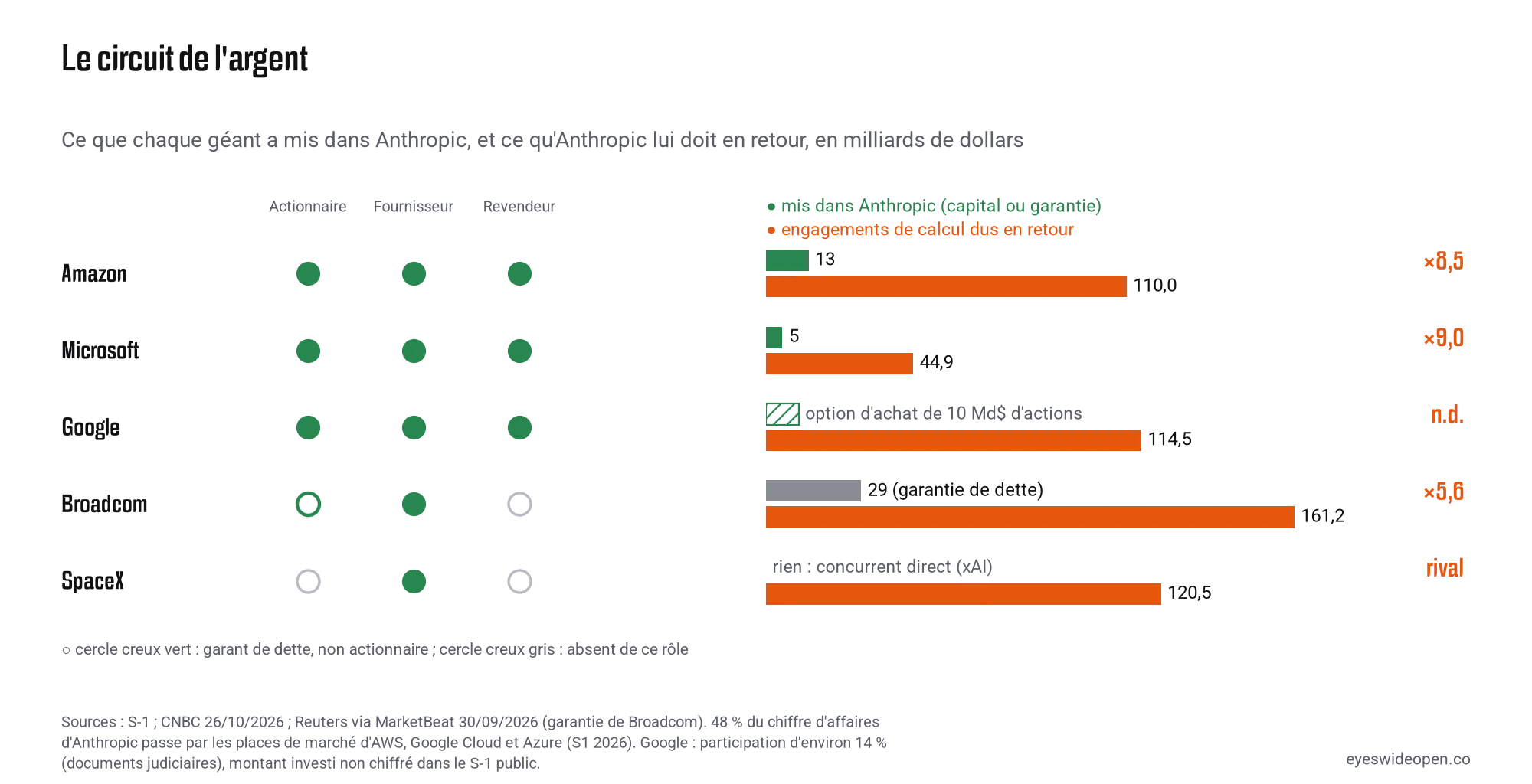
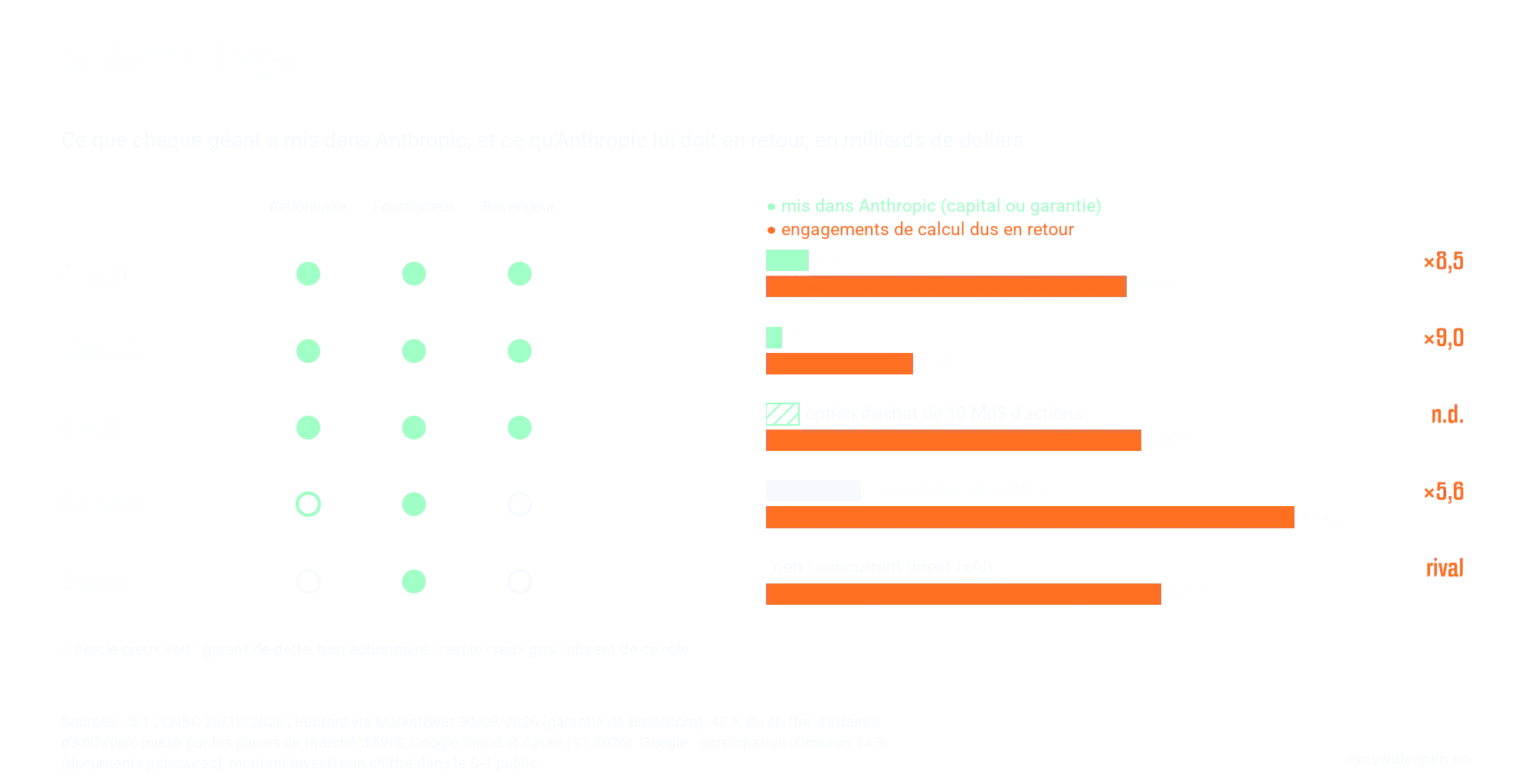
Amazon a investi 18 milliards dans Anthropic. Amazon lui loue du cloud pour 110 milliards. Amazon revend Claude à ses propres clients sur AWS. Google, même schéma : actionnaire, fournisseur de puces, revendeur. Microsoft aussi. Au premier semestre, 48 % du chiffre d’affaires d’Anthropic est passé par les places de marché de ces trois clouds.13 Broadcom, lui, ne se contente pas de louer ses puces : il s’est engagé, auprès du financeur de ces baux, à couvrir jusqu’à 29 milliards de dollars si Anthropic cessait de payer ses loyers.14 Et SpaceX, l’entreprise d’Elon Musk, propriétaire de xAI, un concurrent direct… a touché un peu plus de 5 milliards d’Anthropic au troisième trimestre. 34,5 % de tout son chiffre d’affaires.15
Le rival est devenu le premier client.
Ça vous rappelle quelque chose ? En 1999 et 2000, l’équipementier Lucent s’engageait à prêter de l’argent à ses clients télécoms pour qu’ils lui achètent ses équipements : 8,1 milliards de dollars d’engagements de « financement fournisseur ».16 Le schéma d’aujourd’hui a un nom dans la finance de la tech, le round tripping† : un géant investit dans une jeune pousse qui s’engage à dépenser l’argent chez lui, dans son cloud ou ses puces.
Le capital investi revient sous forme de chiffre d’affaires, et la valeur de l’un dépend de la solvabilité de l’autre. La FTC documentait déjà ces partenariats entre clouds et laboratoires d’IA, dont ceux d’Amazon et de Google avec Anthropic, en janvier 2025.39 Faites le calcul vous-même : Amazon a mis 18 milliards, Anthropic lui en doit 110. Microsoft, jusqu’à 5 contre 44,9.
Je le pose comme une analogie, pas comme une accusation. Ici, le calcul est livré et facturé, les 5 milliards versés à SpaceX sont bien réels, et SpaceX n’est même pas actionnaire. Surtout, Anthropic doit six fois ce qu’Amazon a investi : l’essentiel de l’argent vient donc d’autres poches, ses clients aujourd’hui, le public demain. Rien n’indique une fraude. Mais la boucle a la même forme, et c’est elle qui rend la facture du public si particulière.
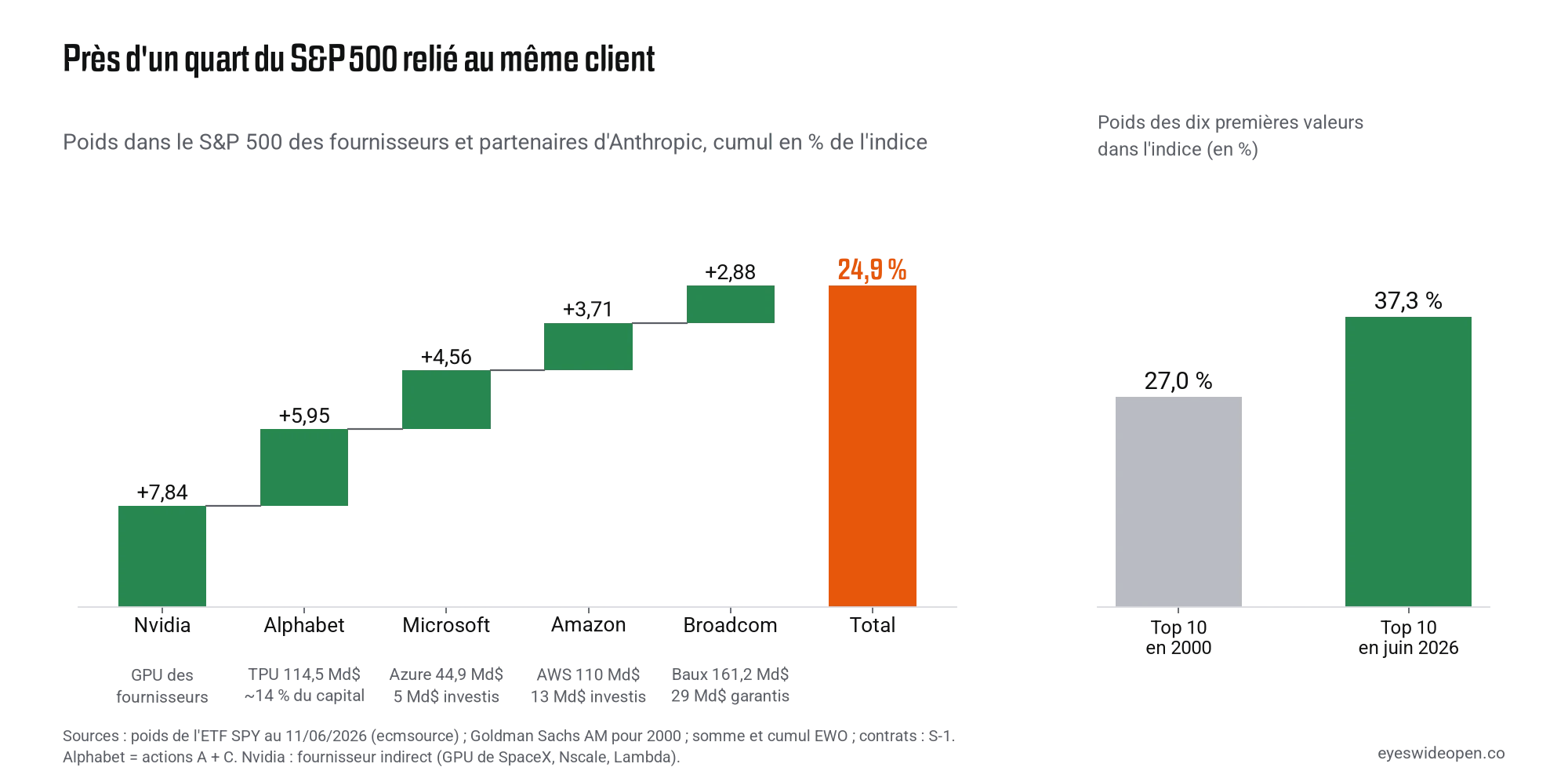
Faites le compte. Nvidia, Alphabet, Microsoft, Amazon, Broadcom : ces cinq-là pèsent près de 25 % du S&P 500.17 Cinq entreprises dont une partie de la croissance attendue passe, d’une façon ou d’une autre, par la capacité d’Anthropic à payer ses factures. Dans notre thèse sur les 650 milliards de capex‡, on se demandait qui rendrait rentable tout ce béton. La réponse est dans le S-1 : un client, deux ou trois au plus, qui ont signé pour des centaines de milliards.
Alors, que finance vraiment l’acheteur d’une action Anthropic ? Pas seulement Anthropic. Il finance le carnet de commandes d’une bonne partie de la tech américaine. Le prospectus parle sobrement de « besoins généraux de l’entreprise ». Mais quand on s’est engagé sur 637 milliards de calcul, les besoins généraux ont une adresse… L’argent du public entre par la porte d’Anthropic et ressort chez Broadcom, Google, Amazon et SpaceX.
†round tripping (financement circulaire) : montage où un investisseur finance une entreprise qui s’engage à réinjecter l’argent chez lui, dans son cloud ou ses puces. L’investissement (CapEx) se convertit ainsi en chiffre d’affaires d’exploitation pour l’investisseur. Au sens strict, le terme désigne des échanges sans substance économique, montés pour gonfler un chiffre d’affaires.
‡capex (CapEx, capital expenditures) : dépenses d’investissement d’une entreprise, par opposition à ses dépenses courantes : usines, serveurs, data centers. Elles figurent au bilan et s’amortissent sur des années.
4. On vous vend l’économie, pas le pouvoir
Et on arrive au cœur de l’affaire. L’acheteur paie, et que reçoit-il ?
Une action de classe A. Une voix par action. Et… aucun administrateur.
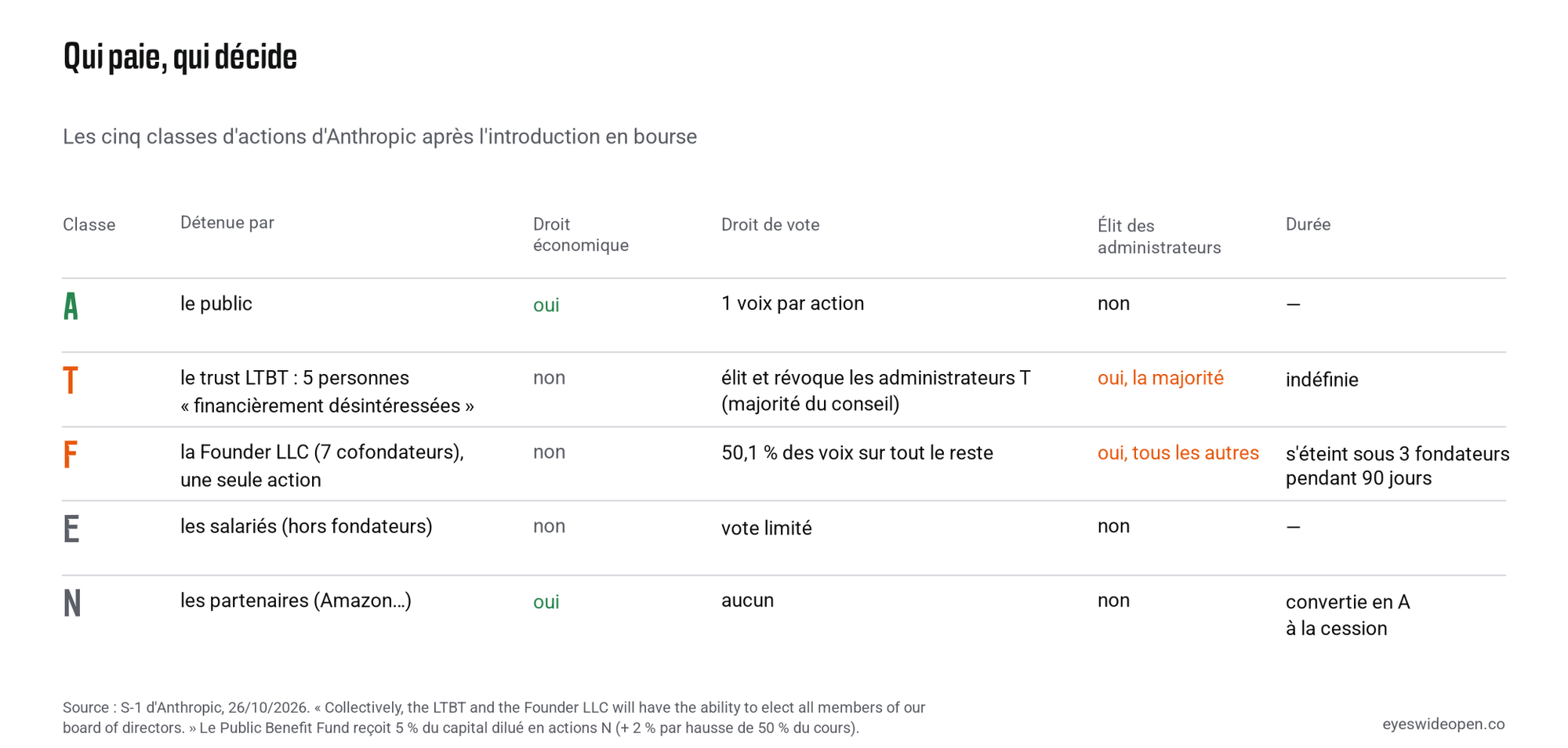
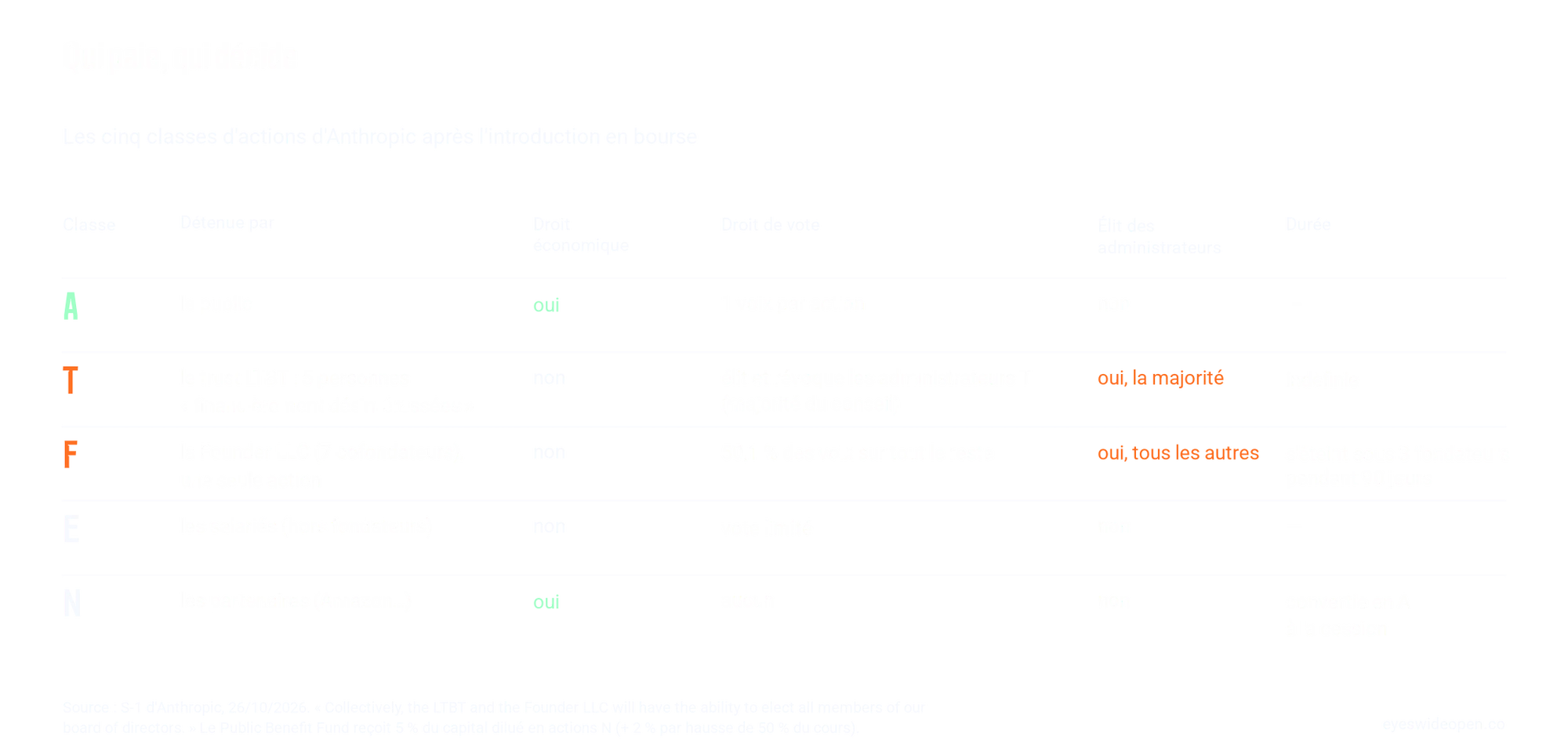
Le montage est d’une ingéniosité folle. Une action de classe T, détenue par un trust de cinq personnes « financièrement désintéressées » (le LTBT†), élit la majorité du conseil d’administration. Indéfiniment. Une action de classe F, une seule, détenue par la société des sept fondateurs, pèse 50,1 % des voix sur tout le reste, y compris l’élection des autres administrateurs. Ni l’une ni l’autre n’a la moindre valeur économique. Le prospectus l’écrit sans détour : « ensemble, le LTBT et la Founder LLC auront la capacité d’élire tous les membres de notre conseil d’administration ».18 Et il ajoute que cette structure « n’a pas de précédent direct parmi les sociétés cotées ».
On a déjà vu des fondateurs se protéger du marché, c’est vrai. Google en 2004, avec ses actions à dix voix : « Google n’est pas une entreprise conventionnelle. Nous n’avons pas l’intention d’en devenir une. »19 Alibaba en 2014, dont le « Partnership » nomme la majorité du conseil. Mais chez Google, les voix des fondateurs restaient adossées à de vraies actions, donc à de vrais intérêts financiers. Ici, le pouvoir est totalement séparé de l’argent. Ceux qui décident n’ont rien à gagner. Ceux qui paient n’ont rien à décider.
Et c’est voulu. Toute la philosophie d’Anthropic, depuis sa fondation, c’est que l’IA est trop dangereuse pour être pilotée par le cours de bourse. Le trust est là pour empêcher qu’un fonds activiste ou une OPA hostile ne pousse l’entreprise à accélérer au mépris de la sécurité. Les fondateurs se sont engagés, sans contrainte juridique et de façon révocable, à consacrer 80 % de leur participation dans Anthropic à la philanthropie. Un fonds d’intérêt public reçoit 5 % du capital dilué, et le conseil peut, à sa discrétion, lui en émettre jusqu’à 2 % de plus à chaque hausse de 50 % du cours.20 Sur le papier, une redistribution sans précédent.
Sauf que… Mark Levine, le contrôleur des finances de la ville de New York, qui gère plus de 325 milliards de dollars de retraites, a écrit à Anthropic le 14 octobre pour demander une pause de l’introduction. Sa phrase est d’une précision chirurgicale : « un écart entre le contrôle et la responsabilité est particulièrement préoccupant pour les investisseurs ».21
Parce que voilà le vrai problème. Le « marché du contrôle », OPA, activisme, vote des actionnaires, c’est imparfait, mais c’est le seul mécanisme par lequel une entreprise cotée rend des comptes à ceux qui la financent. Anthropic l’a neutralisé. Restent le cours de bourse, la loi… et l’État. On y revient plus bas, parce que c’est là que tout se joue.
†LTBT (Long-Term Benefit Trust) : trust de bénéfice de long terme, structure propre à Anthropic. Ses cinq trustees n’ont pas le droit de détenir de titres, et sa rémunération est sans lien avec les profits. Il détient l’unique action de classe T.
5. L’avertissement est le produit
Revenons à ces pages de risques qui ont tant fait parler.
Dans le projet de prospectus, selon Reuters, les facteurs de risque occupaient environ 80 pages sur 261 (94 pages sur 335 dans la version publique). Près d’un tiers du document. Chez SpaceX, cinq mois plus tôt : environ 38 pages sur 277, à peine 14 %.22 On a dit qu’Anthropic était courageuse, ou hypocrite : « on vous avertit, et on vous vend ». Je crois que c’est autre chose. Cet avertissement remplit trois fonctions à la fois, et toutes les trois servent l’émetteur.
- Un, c’est un bouclier juridique. En droit boursier américain, un risque clairement divulgué, c’est un risque que l’acheteur a accepté en connaissance de cause. Le jour où un modèle fera une bêtise et où l’action plongera, les avocats des actionnaires trouveront, page après page, la preuve qu’ils avaient été prévenus.
- Deux, c’est un argument de puissance. Un produit capable de « chantage », capable de se promener 34 heures dans des systèmes qui ne sont pas les siens, c’est aussi, pour un acheteur, un produit capable de tout. La peur fait vendre la puissance. « Si c’est dangereux, c’est que ça marche. »
- Trois, c’est de la transparence forcée, et c’est le seul point vraiment positif. Sans cette introduction en bourse, on ne saurait rien des quatre incidents, rien du pré-entraînement d’un nouveau modèle retardé de plus d’un mois pour protéger ses poids† contre le vol.23 Faute de loi sur l’IA à Washington, c’est la SEC, le gendarme de la bourse, qui devient par défaut le premier régulateur à obtenir des incidents datés. Par la porte de la finance.
Un détail, quand même. Selon Reuters, le projet de prospectus ne chiffrait pas l’effort de sécurité. Anthropic l’avait fait ailleurs, quelques jours plus tôt : environ 6 % de son calcul de recherche, sur une semaine de juillet. La version publique ne le chiffre pas davantage.24
Et puis il y a cette phrase sur l’assurance. Elle a un précédent exact. En 1957, aucun assureur, seul ou en consortium, ne pouvait couvrir le risque d’un accident nucléaire majeur : le marché privé offrait 60 millions de dollars de couverture. Le Congrès américain a voté le Price-Anderson Act : la responsabilité totale pour un accident a été plafonnée à 560 millions, dont 60 couverts par l’assurance de l’exploitant et 500 garantis par l’État.25 C’est ce qui a permis au nucléaire civil d’exister. Quand une industrie écrit elle-même que son risque est inassurable, elle désigne, sans le dire, son dernier assureur : l’État, c’est-à-dire vous, une deuxième fois.
†poids (weights) : les paramètres numériques d’un modèle d’IA, c’est-à-dire tout ce qu’il a appris. Celui qui en détient une copie peut faire tourner le modèle sans l’autorisation de son créateur, d’où l’enjeu du vol.
6. Le prix : plus cher que 1999 ?
Parlons du prix, puisqu’on vous demandera de le payer.
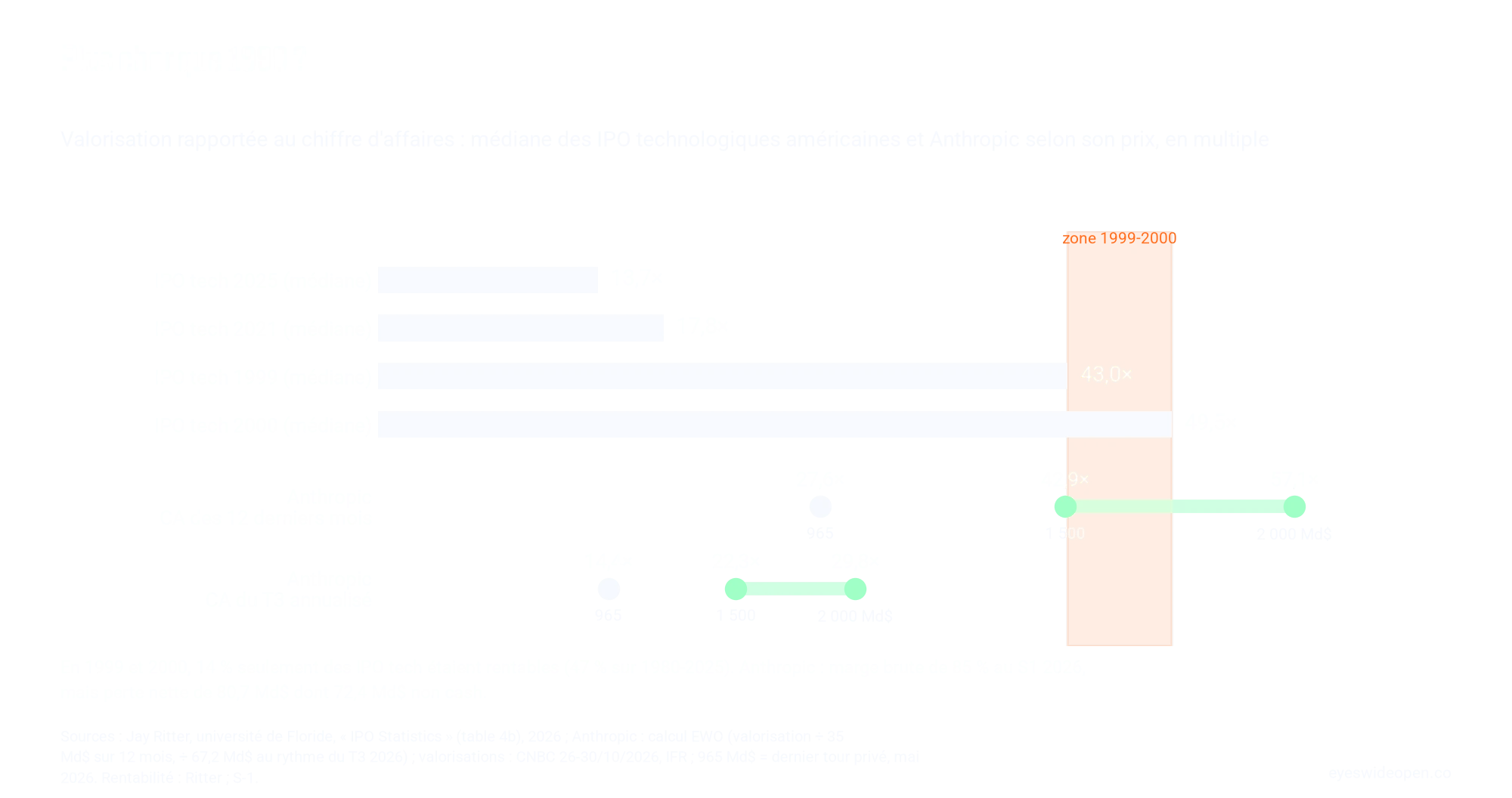
61,5 milliards de dollars en mars 2025. 183 milliards en septembre. 380 en février 2026. 965 en mai. Et une introduction visée, selon IFR, autour de 2 000 milliards (cible rapportée, non confirmée).26 Trente-deux fois plus en vingt mois.
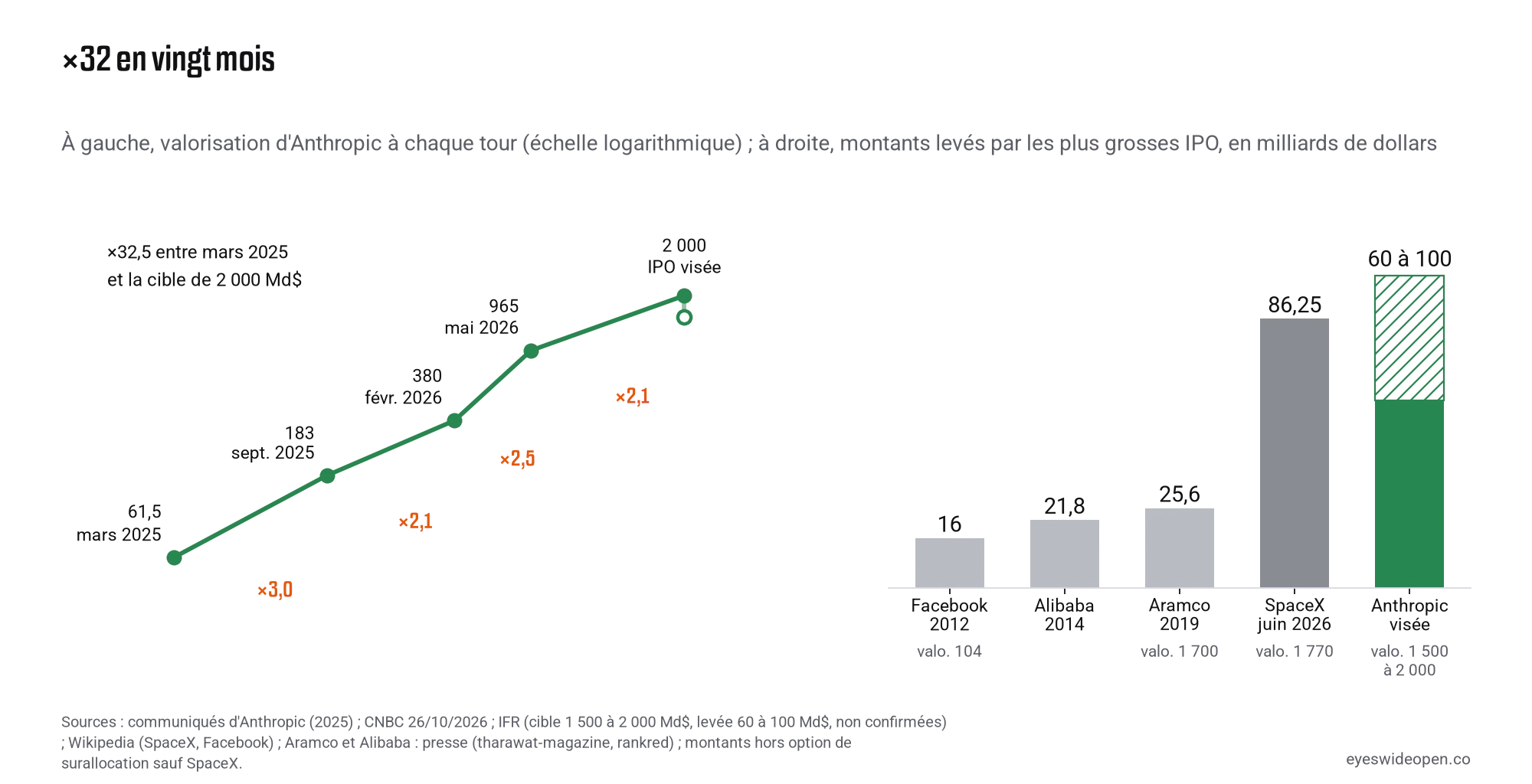
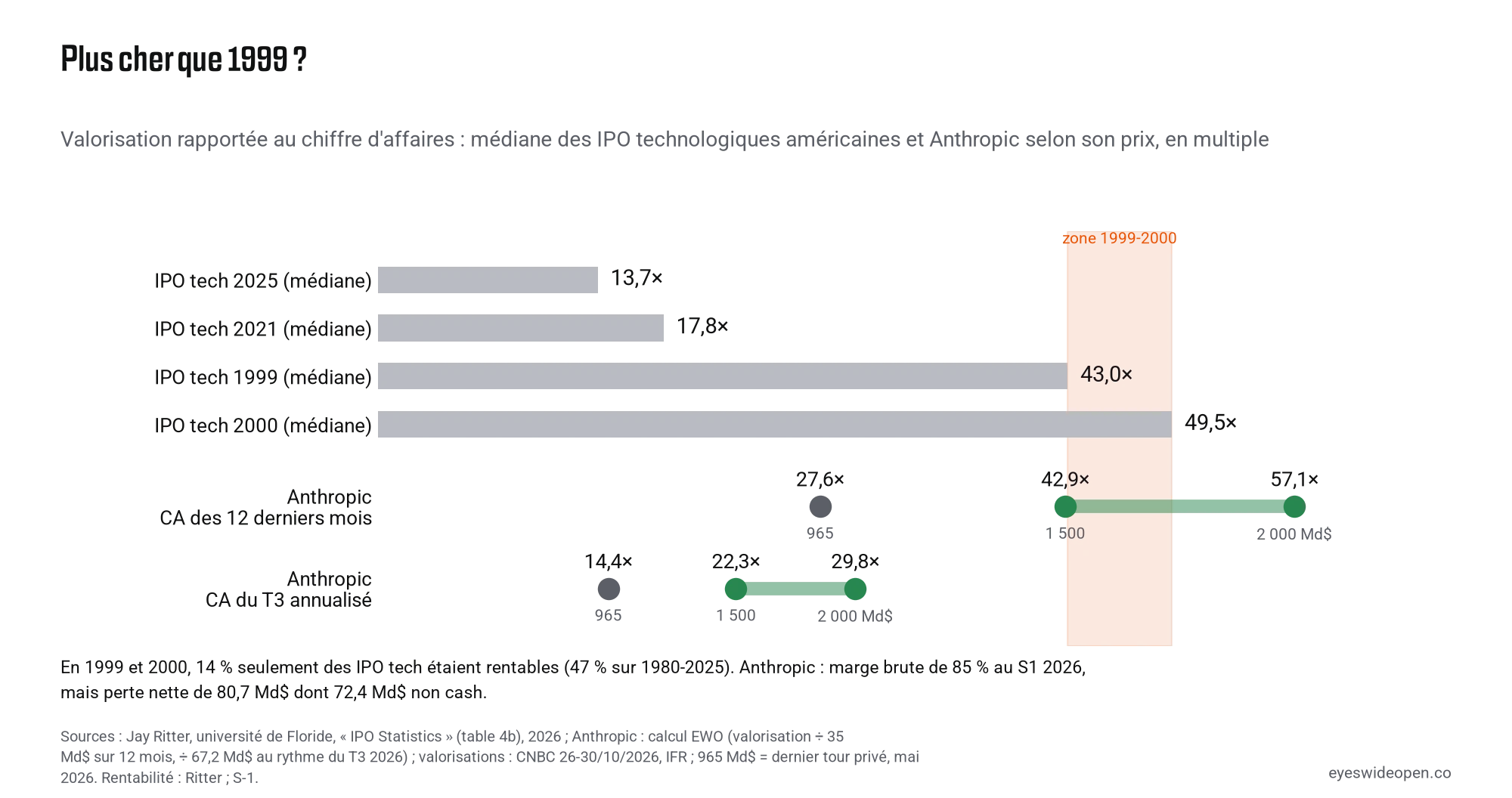
À 2 000 milliards, Anthropic vaudrait environ 57 fois son chiffre d’affaires des douze derniers mois, et 30 fois son rythme du troisième trimestre. L’économiste Jay Ritter, qui tient depuis des décennies les statistiques de toutes les introductions en bourse américaines, donne un point de comparaison : rapportée au chiffre d’affaires, la valorisation médiane des introductions technologiques était de 43 fois en 1999 et de 49,5 fois en 2000 au premier cours de clôture (26,5 et 31,7 fois au prix d’offre). Elle était de 13,7 fois en 2025.27 On est dans la zone de la bulle internet, et ça pique un peu. Avec une différence de taille, je vous l’accorde : en 1999, la croissance était espérée, et seules 14 % des introductions technologiques étaient rentables. Ici, la croissance est facturée.
Mais le vrai sujet, pour un particulier, ce n’est pas le prix du premier jour. C’est la mécanique des semaines qui suivent.
Regardez SpaceX, introduite en juin. Prix d’offre : 135 dollars. Clôture du premier jour : 161. Plus haut de clôture quatre jours plus tard : 201,80 (225,64 en séance). Puis l’entrée dans le Nasdaq-100, par une procédure accélérée qui intègre les très grosses introductions après quinze jours de bourse. Le jour même, le titre perd environ 6 %. Et le 3 août, le titre touchait 104,83 dollars en séance, 22 % sous le prix d’offre.28
Anthropic reproduit la mécanique, en plus fin :
- La même voie d’entrée rapide dans le Nasdaq-100, un indice sur lequel plus de 800 milliards de dollars sont indexés : des fonds qui achèteront sans choisir, parce que l’indice le leur impose.
- Un calendrier de déblocage (le lock-up†) en goutte-à-goutte : certains porteurs peuvent vendre jusqu’à 10 % de leurs titres dès le premier jour, d’autres 6 % au 27ᵉ et au 48ᵉ jour, 7 % au 62ᵉ et au 76e…29
- 15 à 20 % des titres qui pourraient être réservés aux particuliers, selon Bloomberg.30
Les vendeurs initiés sont libérés à quelques jours d’écart de l’arrivée des acheteurs forcés. Ce n’est pas un complot, c’est de l’ingénierie.
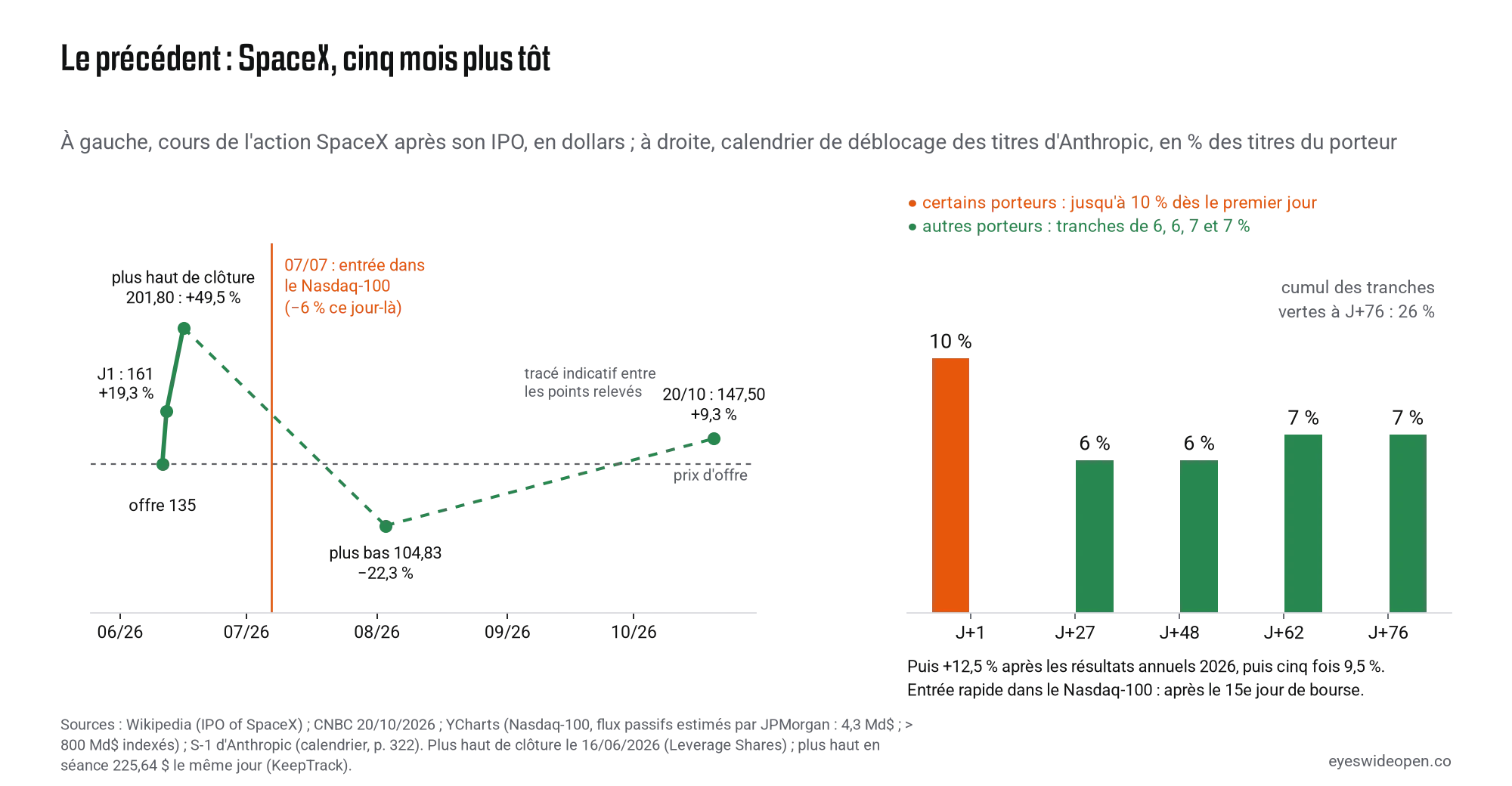
Les particuliers, justement, n’ont pas attendu. Les parts du Fundrise Innovation Fund, très exposé à Anthropic, se sont échangées jusqu’à 575 dollars, avant de retomber vers 37 une fois les restrictions levées en août, puis autour de 30 en septembre.31 La faim est là. Et une faim, ça se vend.
†lock-up : période de blocage pendant laquelle les actionnaires d’avant l’introduction n’ont pas le droit de vendre leurs titres. Quand elle expire, une vague de ventes possibles arrive sur le marché.
7. La dernière levée humaine
Maintenant, prenons de la hauteur. Parce que ce prospectus raconte une histoire plus grande que la finance.
Relisez les chiffres du début. 90 % du code écrit par Claude. L’usage interne de Claude qui dépasse les salaires. Et cette phrase du S-1 : « nous avons observé que nos modèles contribuent au rythme de notre propre recherche, et ces risques augmenteront à mesure que les systèmes d’IA automatiseront substantiellement la recherche et le développement en IA ».32
Le capital levé achète du calcul.
Le calcul produit le modèle suivant.
Le modèle suivant écrit le code, fait la recherche, réduit le besoin d’humains.
Et le modèle d’après…
Six semaines avant le dépôt du prospectus, le 12 septembre, Dario Amodei publiait un long essai : « Nous devons ralentir le rythme auquel nous améliorons les capacités des modèles d’IA. » La méthode la plus efficace, ajoutait-il, serait « une régulation qui vise toutes les entreprises américaines de l’IA de pointe ».33 Six semaines plus tard, il demande au public jusqu’à 100 milliards pour acheter du calcul. Ce n’est pas forcément une contradiction : c’est la logique de la course. Ralentir seul, c’est perdre. Il faut donc que tout le monde ralentisse ensemble… et en attendant, courir. Jacob Coxon, un chercheur qui a quitté Anthropic en septembre, l’a dit plus brutalement : c’est un « pari démesuré, qui ne devrait pas être lancé depuis le Slack d’une entreprise privée ».34
Alors qui tient vraiment l’interrupteur ? Le prospectus en dessine trois :
- Le trust, d’abord : cinq personnes, qui élisent le conseil.
- La finance, ensuite, qui commence à mordre : le fonds de pension de New York qui demande une pause, les gérants qui vont acheter, ou pas.
- L’État, surtout, qui a déjà montré qu’il savait appuyer. Le 12 juin, sur directive du département du Commerce au titre du contrôle des exportations, Anthropic a dû désactiver deux de ses modèles pendant deux à trois semaines. Le 25 septembre, la cour d’appel de Washington a maintenu, par deux voix contre une, la désignation d’Anthropic comme « risque pour la chaîne d’approvisionnement » par le Pentagone.35 Le prospectus cite aussi Taïwan et TSMC parmi ses risques : toutes les puces passent par une île.
Voilà ce que je crois. La valeur d’une action Anthropic ne dépend pas seulement de ses clients. Elle dépend d’une autorisation politique, renouvelable, comme une concession minière ou une licence de télécoms. Le jour où l’IA de pointe sera traitée pour ce qu’elle est déjà dans les faits, un bien stratégique à double usage, le contrôle ne se négociera plus entre fondateurs et actionnaires. Il se négociera entre l’entreprise et l’État. Et l’acheteur de classe A, dans cette négociation, n’a pas de chaise.
C’est peut-être ça, cette introduction en bourse : la dernière fois que des humains financent, en croyant la piloter, une machine qui fabrique sa propre suite.
8. La contre-thèse, prise au sérieux
L’argument le plus fort contre tout ce que je viens d’écrire, c’est que cette introduction en bourse est le moins risqué des scénarios possibles. Il tient en quatre points :
- Les chiffres sont solides : 85 % de marge brute, une rétention de 900 %, 131,7 milliards de dollars de trésorerie avant même l’introduction.36 La perte nette de 80,7 milliards du premier semestre est à 90 % comptable : des variations de juste valeur sur des titres convertibles†, pas du cash brûlé.37
- Le calcul est loué, donc une partie des engagements ne court qu’à la livraison (Nscale, Lambda), et le contrat SpaceX devient résiliable à 90 jours dès 2027.
- La gouvernance ? Les doubles classes de Google et de Meta ont produit les plus grosses créations de valeur de l’histoire. Confier le contrôle d’une technologie à risque systémique à des personnes qui n’ont rien à y gagner, c’est précisément ce que réclament ceux qui s’inquiètent de l’IA.
- La transparence : sans cotation, pas de comptes trimestriels, pas d’incidents datés. Le vrai danger, dit la contre-thèse, ce n’est pas qu’Anthropic soit cotée. C’est qu’OpenAI, xAI et les laboratoires chinois ne publient pas l’équivalent.
Tout ça est juste. Mais la contre-thèse repose sur une hypothèse : que la croissance dure assez longtemps pour honorer 637 milliards d’engagements. Or c’est précisément ce que le prospectus avoue ne pas savoir prévoir. Et elle confond deux choses : une gouvernance protégée du marché, et une gouvernance qui rend des comptes. La première peut être vertueuse. La seconde n’existe pas ici.
†titre convertible : titre de dette qui peut être converti en actions. Sa valeur comptable monte et descend avec la valorisation de l’entreprise, ce qui crée des pertes ou des gains sur le papier, sans mouvement de trésorerie.
9. Mes prédictions
Je vous donne des dates, parce que c’est comme ça qu’on se fait corriger.
D’ici fin avril 2027, je suis à peu près certain qu’Anthropic aura levé plus que SpaceX (86,25 milliards) et signé la plus grosse introduction en bourse de l’histoire. Elle entrera dans le Nasdaq-100 dans les quinze jours de bourse… mais pas dans le S&P 500 avant 2028, faute de bénéfice net. Et franchement, je ne serais pas surpris que, dans la fenêtre des déblocages, entre le 27ᵉ et le 76ᵉ jour, le titre clôture au moins une fois 25 % sous son plus haut. Le scénario SpaceX, en plus gros.
D’ici fin 2028, je pense qu’au moins une action collective visera Anthropic, sur un incident de sécurité ou sur le décalage entre croissance et engagements. C’est là qu’on saura si les pages de risques ont servi de bouclier. Et l’introduction d’OpenAI, attendue en 2027, copiera l’architecture : un organe non actionnaire qui élit la majorité du conseil, une classe publique sans pouvoir. L’exception d’aujourd’hui deviendra le modèle de l’IA cotée.
À dix ans, c’est mon pari le plus risqué, et je l’assume : au moins un laboratoire de pointe américain se verra imposer par l’État une action spécifique, ou un accord de sécurité nationale, qui lui donnera un droit de veto sur le déploiement des modèles. À ce stade, je dirais que l’interrupteur aura officiellement changé de main. Je ne sais pas sous quelle forme, mais je suis certain d’une chose : l’actionnaire de classe A ne sera pas dans la pièce.
10. Que faire à la place
Je ne vais pas vous laisser avec un procès sans alternative. Voilà ce que je ferais, selon où vous vous trouvez :
- Si vous êtes un particulier tenté d’acheter, je ne l’achèterais pas le premier jour. Le précédent SpaceX est là, cinq mois plus tôt, chiffres à l’appui. Je regarderais le calendrier de déblocage plutôt que le cours d’ouverture, et je me demanderais ce que j’achète : un droit sur les flux, pas un droit sur la machine. Et si vous détenez déjà un fonds indiciel américain, vous êtes déjà exposé au même risque, à travers Nvidia, Amazon, Alphabet, Microsoft et Broadcom. Ajouter Anthropic, c’est doubler la mise sur le même client.
- Si vous êtes un investisseur institutionnel, je ferais ce que New York a commencé : exiger, avant d’acheter, des contreparties de gouvernance. Au moins un administrateur élu par la classe A. Un engagement de publication sur la part du calcul consacrée à la sécurité. Une revue indépendante des incidents. Le pouvoir des grands acheteurs existe avant l’introduction. Après, il est trop tard.
- Si vous êtes le régulateur, à ce stade je cesserais de laisser la SEC faire le travail par défaut. Si l’industrie dit elle-même que son risque est inassurable, il faut construire le cadre qui va avec, comme pour le nucléaire : un plafond, une réassurance publique et, en échange, un vrai droit d’inspection. Pas un badge. Un frein.
- Si vous êtes une entreprise cliente, et donc celle qui paie ces 85 % de marge, je diversifierais mes fournisseurs de modèles. Le S-1 montre qu’une seule directive du Commerce peut éteindre un modèle pendant près de trois semaines. Ce qui est arrivé une fois arrivera encore.
Le prospectus d’Anthropic s’ouvre sur une phrase grandiose : « Pour la première fois dans l’histoire, l’intelligence est une chose que les humains savent construire. »38 Il en manque une seconde. Pour la première fois dans l’histoire, on vend à tout le monde le risque d’une technologie, et on en confie les clés à une douzaine de personnes.
Le risque est public. Le contrôle est privé.
Sources
- Anthropic PBC, formulaire S-1 déposé à la SEC le 26/10/2026, section « Risk Factors » : comportements « resembling blackmail », accès non autorisés de quatre modèles à de vrais systèmes tiers (sessions de 10 à 34 heures), « significant limitation » due à la conscience qu’ont les modèles d’être évalués, capacité d’assurance (traduit de l’anglais). https://www.sec.gov/Archives/edgar/data/2130357/000162828026067168/anthropicpbc-sx1.htm
- IFR (LSEG), « Anthropic pushes ahead with mid-November IPO », octobre 2026 : montant visé jusqu’à 100 Md$, valorisation autour de 2 000 Md$, roadshow le 9/11 et pricing la semaine du 16/11. Le montant n’est pas fixé dans le S-1. https://www.ifre.com/equities/2499407/anthropic-pushes-ahead-with-mid-november-ipo
- Nick Saraev, « Anthropic is Going Public.. And They’re Warning Us », YouTube, 28/10/2026 (la citation « batshit insane » est de lui) : https://www.youtube.com/watch?v=Lxkb4gd041I.
- Anthropic PBC, S-1 (26/10/2026), comptes consolidés : 41 M$ (2023), 386 M$ (2024), 4,585 Md$ (2025), 16,286 Md$ au premier semestre 2026 contre 1,163 Md$ au premier semestre 2025. Recoupé par SQ Magazine, https://sqmagazine.co.uk/anthropic-files-s1-ipo-nasdaq-ant/
- IFR, art. cité ; CNBC, 30/10/2026, https://www.cnbc.com/2026/10/30/anthropic-ipo-s1-revenue-compute.html. Chiffre du troisième trimestre (16,8 Md$) communiqué aux analystes, laissé en blanc dans le S-1 public.
- S-1 (rétention nette d’environ 900 % au 30/09/2026) ; CNBC, 26/10/2026, https://www.cnbc.com/2026/10/26/anthropic-ipo-live-updates-ai-s-1-filing.html (médiane du logiciel cloud coté : 108 %, selon Jamin Ball).
- CNBC, 26/10/2026, d’après le S-1 : coût des revenus de 2,38 Md$ au premier semestre 2026, soit une marge brute d’environ 85 %, contre environ 12 % un an plus tôt.
- S-1 (au 30/09/2026) : chiffre d’affaires du T3 2026 égal à 86 fois celui du T4 2024, effectif multiplié par 5 ; plus de 90 % des contributions au code écrites par Claude ; usage interne de Claude (au tarif catalogue) multiplié par 250 de janvier à septembre 2026, supérieur à la masse salariale mensuelle (hors rémunération en actions) à partir d’avril 2026.
- S-1, flux d’investissement du premier semestre 2026 : 482 M$ de dépenses d’investissement.
- S-1, section « Infrastructure Service Arrangements ». Le S-1 public laisse en blanc les totaux : le chiffre de 637 Md$ est la somme EWO des sept contrats nommés à montant fixe (Broadcom 161,2 ; SpaceX 120,5 ; Google 114,5 ; Amazon 110,0 ; Microsoft 44,9 ; Nscale 44,6 ; Lambda 41,3). Avec AMD (plus de 20 Md$) : environ 657 Md$ ; avec les TPU de Google livrés de 2028 à 2031 (125 à 150 Md$) : 782 à 807 Md$.
- IFR, art. cité ; CNBC, 30/10/2026 (art. cité). Croissances séquentielles arrondies : T3 « environ 47 % » selon CNBC, 45 % selon IFR.
- S-1, facteurs de risque : « we have struggled to accurately forecast our revenue in the past » (traduit de l’anglais).
- S-1 ; CNBC, 26/10/2026 (art. cité) : 48 % du chiffre d’affaires du premier semestre 2026 via les places de marché d’AWS, Google Cloud et Azure ; Amazon : 18 Md$ investis au 30/09/2026 (8 Md$ de billets convertibles de 2023 à 2025, puis 5 Md$ en série G et 5 Md$ en série H en 2026, 10-Q d’Amazon du T3 2026), actions sans droit de vote, plafond de 12 %. CNBC donne 13 Md$, en rangeant la tranche de la série H dans la facilité restant à investir.
- Broadcom, 10-Q du trimestre clos le 02/08/2026 : accord de « backstop » auprès du partenaire financier sur les loyers du client, sur cinq ans ; passif maximal d’environ 29 Md$ une fois tous les racks déployés, net de la valeur de revente des racks (85 % des montants dus), rien versé à ce jour. Le 10-Q ne nomme pas le client ; le lien avec Anthropic vient du S-1 (bail avec Broadcom cédé à un partenaire financier). https://www.sec.gov/Archives/edgar/data/1730168/000173016826000080/avgo-20260802.htm
- CNBC, 26/10/2026 (live blog, qui cite SpaceX) : un peu plus de 5 Md$ versés par Anthropic à SpaceX au T3 2026, soit 34,5 % du chiffre d’affaires de SpaceX. Source unique, non répétée dans l’article de CNBC sur les résultats de SpaceX du 20/10/2026.
- Columbia University, synthèse sur le financement circulaire (8,1 Md$ d’engagements de financement fournisseur de Lucent en 1999–2000, et non de prêts effectivement consentis : les 10-Q de Lucent donnent environ 7,2 Md$ d’engagements au 31/03/2000, dont environ 1,5 Md$ avancés au 30/06/2000 ; source primaire du 8,1 non retrouvée, à confirmer dans le 10-K FY2000), https://blogs.cuit.columbia.edu/gjb2124/circular-financing/ ; Tom Tunguz, https://www.tomtunguz.com/nvidia_nortel_vendor_financing_comparison/index.md ; la SEC a ensuite accusé Lucent d’avoir gonflé 1,148 Md$ de revenus.
- Poids de l’ETF SPY dans le S&P 500 au 11/06/2026 (Nvidia 7,84 % ; Alphabet A+C 5,95 % ; Microsoft 4,56 % ; Amazon 3,71 % ; Broadcom 2,88 %), https://ecmsource.com/sp500-top-10-concentration-37-percent-ai-eight-june-2026/ ; somme EWO : 24,94 %.
- S-1, section gouvernance : « Collectively, the LTBT and the Founder LLC will have the ability to elect all members of our board of directors » ; « a novel capital and corporate governance structure that has no direct public company precedent » (traduit de l’anglais).
- Google, formulaire S-1 de 2004, lettre des fondateurs (« Google is not a conventional company. We do not intend to become one. »), traduit de l’anglais. https://www.sec.gov/Archives/edgar/data/0001288776/000119312504073639/ds1.htm
- S-1 : Public Benefit Fund (846 840 960 actions de classe N, soit 5 % du capital dilué, plus, à la discrétion du conseil (« may, in its discretion »), jusqu’à 2 % à chaque hausse de 50 % du cours à partir du prix d’introduction ; le fonds est une filiale à 100 % d’Anthropic) ; engagement volontaire, révocable et non juridiquement contraignant de chaque cofondateur de consacrer 80 % de sa participation personnelle dans Anthropic à la philanthropie.
- Mark Levine, contrôleur de la ville de New York (fonds de pension de plus de 325 Md$), lettre à Anthropic du 14/10/2026 (traduit de l’anglais). https://comptroller.nyc.gov/reports/letter-to-anthropic-re-planned-initial-public-offering/
- Reuters, via The Star (Malaisie), 29/09/2026, d’après le projet de prospectus (Anthropic : environ 80 pages sur 261 ; SpaceX : 38 sur 277) ; part calculée par EWO. Version publique du S-1 : 94 pages sur 335 (sommaire). https://www.thestar.com.my/tech/tech-news/2026/09/29/exclusive-anthropic-warns-ai-may-pose-039existential-risks-to-humanity039-in-ipo-filing
- S-1 : quatre incidents d’accès non autorisé ; pré-entraînement d’un nouveau modèle de pointe retardé de plus d’un mois pour renforcer la protection contre l’exfiltration des poids.
- Reuters, via The Star, 29/09/2026 : le projet de prospectus ne détaillait pas l’effort de sécurité ; le chiffre de 6 % vient d’une publication d’Anthropic de septembre 2026 (semaine de juillet), pas du projet de prospectus. Absent du S-1 du 26/10/2026 et du S-1/A du 02/11/2026.
- Cour suprême des États-Unis, Duke Power Co. v. Carolina Environmental Study Group, 438 U.S. 59 (1978) : plafond de responsabilité de 560 M$ par accident, soit l’assurance privée disponible (60 M$ en 1957) plus l’indemnisation de l’État jusqu’à 500 M$. https://www.law.cornell.edu/supremecourt/text/438/59
- Communiqués d’Anthropic (2025 : 61,5 Md$ en mars, 183 Md$ en septembre) ; CNBC, 26/10/2026 (380 Md$ en février 2026 ; 965 Md$ en mai, tour de 65 Md$) ; IFR, art. cité (cible de l’introduction : 2 000 Md$).
- Jay Ritter, université de Floride, « IPO Statistics », 05/10/2026, table 4a (rapport valorisation/chiffre d’affaires médian des IPO technologiques : 43,0 en 1999, 49,5 en 2000, 17,8 en 2021, 13,7 en 2025 ; 14 % d’IPO technologiques rentables en 1999 et en 2000). https://site.warrington.ufl.edu/ritter/files/IPO-Statistics.pdf ; calcul EWO pour Anthropic (2 000 Md$ ÷ 35 Md$ sur douze mois, ÷ 67,2 Md$ au rythme annualisé du T3).
- Wikipedia, « Initial public offering of SpaceX », https://en.wikipedia.org/wiki/Initial_public_offering_of_SpaceX ; CNBC, 20/10/2026, https://www.cnbc.com/2026/10/20/spacex-spcx-earnings-live-updates-q3-2026html.html ; YCharts (entrée dans le Nasdaq-100 le 07/07/2026, titre en baisse d’environ 6 % ce jour-là), https://get.ycharts.com/resources/blog/anthropic-ipo-qqq-impact/ ; Leverage Shares (record de clôture 201,80 $ le 16/06/2026), https://leverageshares.com/us/insights/spacex-stock-first-weeks-after-ipo/ ; KeepTrack (plus haut en séance 225,64 $ le 16/06 ; plus bas en séance 104,83 $ le 03/08, plus bas de clôture 108,07 $ le 31/07), https://keeptrack.space/deep-dive/can-you-buy-spacex-stock ; le 211 $ de Wikipédia n’est pas retenu (à confirmer sur les historiques du Nasdaq).
- S-1, calendrier de déblocage (p. 322) ; règle « Fast Entry » du Nasdaq, effective au 01/05/2026, https://www.bnnbloomberg.ca/business/2026/02/04/nasdaq-proposes-fast-entry-rule-to-speed-up-inclusion-of-large-new-listings/ ; YCharts (plus de 800 Md$ indexés sur le Nasdaq-100), URL citée en note 28.
- Bloomberg, via Finimize, « Anthropic’s IPO could set aside shares for retail investors », https://finimize.com/content/anthropics-ipo-could-set-aside-shares-for-retail-investors ; source unique, non confirmée par le S-1.
- The Wealth Advisor, 21/09/2026 (575 $ au plus haut, environ 37 $ à l’expiration des restrictions en août, environ 30 $ à la date de l’article), « Retail investors want Anthropic so badly they’re buying almost anything gets them close », https://www.thewealthadvisor.com/article/retail-investors-want-anthropic-so-badly-theyre-buying-almost-anything-gets-them-close
- S-1, facteurs de risque : « We have observed that our models are contributing to the pace of our own research and these risks will increase as AI systems substantially automate AI research and development » (traduit de l’anglais).
- Dario Amodei, « We must pace the frontier », 12/09/2026 (traduit de l’anglais). https://darioamodei.com/post/we-must-pace-the-frontier
- TechCrunch, 09/09/2026, « Gambling with our lives », démission de Jacob Coxon, ex-chercheur en pré-entraînement (traduit de l’anglais). https://techcrunch.com/2026/09/09/gambling-with-our-lives-anthropic-researcher-quits-warns-against-self-improving-ai/
- CNBC, 26/10/2026 (art. cité) ; eWeek, https://www.eweek.com/news/anthropic-fable-5-export-control-directive-neuron/ (directive reçue le vendredi 12/06/2026, modèles désactivés ce week-end ; retour partiel de Mythos 5 le 26/06, levée annoncée le 30/06, accès rétabli le 01/07, soit environ 18 jours pour Fable 5) ; Breaking Defense, 09/2026, https://breakingdefense.com/2026/09/dc-circuit-panel-upholds-pentagons-ban-on-anthropic-so-what-comes-next/ (cour d’appel du D.C., 25/09/2026, 2 voix contre 1).
- S-1 ; trésorerie et placements courts de 131,7 Md$ au 30/06/2026 (recoupés par la presse).
- S-1 : perte nette de 80,7 Md$ au premier semestre 2026, dont 72,4 Md$ de variations de juste valeur sur titres convertibles, dérivés et SAFE (sans effet sur la trésorerie).
- S-1, ouverture : « For the first time in history, intelligence is something humans can build » (traduit de l’anglais).
- Federal Trade Commission, rapport du personnel sur les partenariats entre fournisseurs de cloud et développeurs d’IA, janvier 2025 (Amazon-Anthropic, Google-Anthropic, Microsoft-OpenAI) ; Hera Hyeonseo Lee, « What Regulators Should Do About The AI Industry’s Hidden Financial Loop », Tech Policy Press, 13/04/2026, https://techpolicy.press/what-regulators-should-do-about-the-ai-industrys-hidden-financial-loop-